
A guide to the skills, coursework and jobs in media production, from the studio to the stadium to your social feed
“Media production is the process of creating any sort of audio, visual or even written content consumed for the purpose of entertainment, business or education,” said Dr. Nathan Adam, associate professor of media production at Belmont University. “Almost anything you see or hear that isn’t happening live has passed through the hands of a media producer.”
One person might shoot, edit and publish a video for a small business. A live broadcast might have separate people running cameras, mixing audio and deciding which shot goes on air. Both projects rely on many of the same skills. The distinction comes with how the work gets divided and how much time the team has to make decisions.
How Does Media Production Work?
Every media project moves through the same basic stages: pre-production, production, post-production and distribution. The scale changes based on the format, but the process of taking a project from execution to distribution stays the same.
Pre-Production
Pre-production is the planning stage. Producers figure out who the piece is for, what it needs to communicate and what the team will need to make it. This is where decisions are made regarding how many cameras will be used, what kind of audio is needed, where filming will take place and how the footage will be stored.
Pre production tasks include:
- Drafting interview questions
- Scouting a location
- Building a shot list
- Securing photo releases
- Coordinating schedules for talent and crew members
For a two-minute profile, the plan might be as simple as one interview and enough footage of the person at work to show what they do.
Production
Production is the capture stage, where the crew records material or puts a live program on air. On a recorded shoot, the crew can adjust lighting, move a microphone or ask for another take. On a live show, the director calls for the next camera angle while the crew keeps the current shot and audio going.
Post-Production
Post-production is where raw footage and audio become a finished piece. Editors organize footage, build a cut and refine the pacing. Depending on the project, finishing can also include mixing dialogue, music and sound effects, matching color between cameras, adding motion graphics and preparing captions.
Distribution
The final stage is bringing the work to its audience. Broadcast media production and distribution involves getting content to viewers through channels such as streaming services, YouTube and social media, and one project often goes out in several versions. A full interview might go on YouTube while a shorter, vertical version with captions goes on social media.
What Do You Learn as a Media Production Major?
Media production majors learn how to plan a shoot, operate cameras, record sound and edit stories for different audiences and platforms. While in school, they'll build a broad base of technical and creative skills so graduates can step into almost any production environment and contribute right away.
“How do I shoot and edit something? How do I light it so it looks good? How do I control the audio on set so that it sounds good?” Adam said, describing the core questions students learn to answer. “Belmont's curriculum prepares students with the context for situations like these.”
Technical Skills
Depending on the course, digital media production coursework can help students build skills in:
- Camera operation and lighting
- Field and studio audio recording and mixing
- Video editing in software like Adobe Premiere Pro and DaVinci Resolve
- Motion graphics in tools like Adobe After Effects
- Color correction
- Image editing and graphic creation in Adobe Photoshop
- Live switching and livestreaming
Studio Media Production
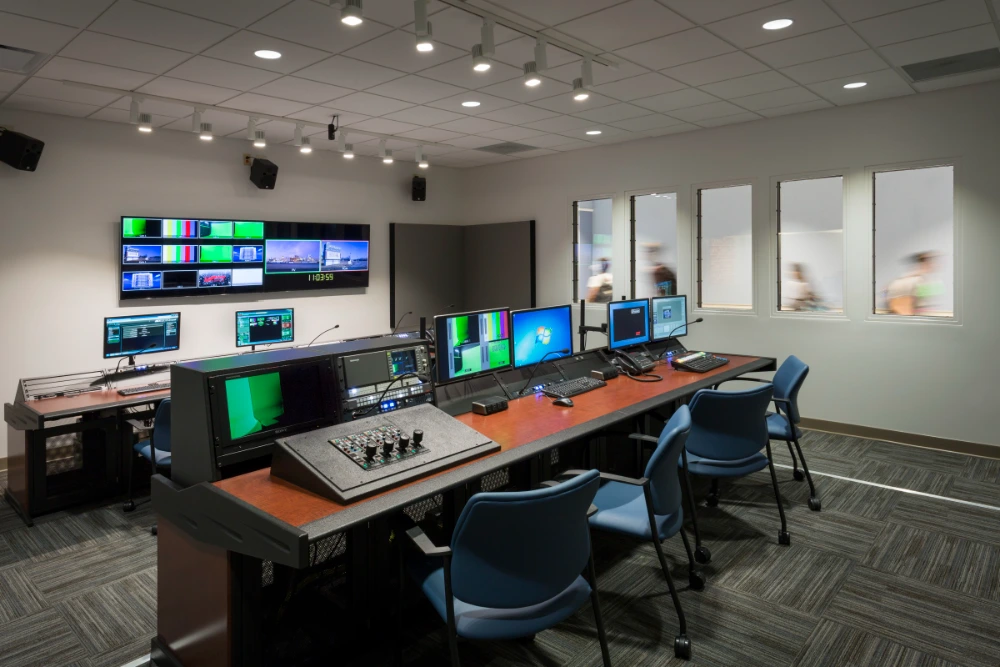
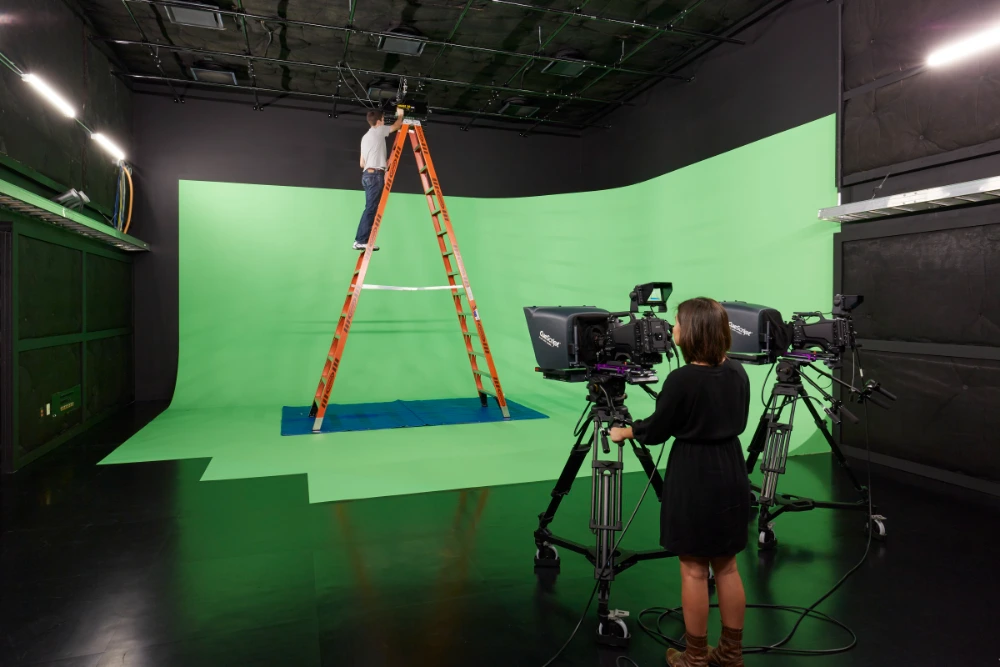
Studio media production teaches students how a crew uses cameras, audio equipment and a production switcher to put a show on air. In a multicamera control room, the director calls the shots while crew members run cameras, switch feeds and match color, so every angle looks consistent. For this to work, clear communication is essential. The same concepts carry over to editing software, so studio skills strengthen everything else.
Design and Media Production Technology
Design and media production technology overlap more than many students expect. A designer working in Photoshop and an editor working in Premiere both build with layers. In a video edit, those layers also help determine when an image appears, how long it stays on screen and what the audience hears alongside it.
“It’s a very interconnected set of skills,” Adam said. “Once you learn one, it becomes much easier to learn the next.”
Storytelling and Strategy
Technical skill is only half the job. Students also learn pre-production, scriptwriting and how to make work that fits a client’s goals. Each producer is faced with the same basic question: “Will this production fit the client's brand?” Courses in visual aesthetics and storytelling help students understand what makes viewers keep watching past the first 30 seconds.
What Jobs Can You Get With a Media Production Degree?
Jobs in media production include video editor, camera operator, podcast producer, technical director and motion graphics designer. These roles span sports, news, marketing, entertainment and live events.
Employers may use different titles for similar work, so pay attention to what a listing asks you to do. A video producer in a small marketing department might handle everything from the first interview to the final export. On a larger production, that same work may be split across several departments.
Below are seven career paths media production graduates can pursue.
Sports Media
What is media production like on game day? Sports production crews help viewers follow the action from wherever they’re watching.
A camera operator follows the play, a replay operator finds the angle that explains what just happened, and a graphics operator keeps scores current. Outside the live show, producers and editors make player profiles, highlights, in-arena video board content and social clips.
Roles to explore — Sports camera operator, replay operator, broadcast graphics operator.
Live and Broadcast Journalism
When a newsroom has a story to get on air, a producer may organize the rundown, the ordered list of stories and segments in a newscast. A news photographer captures interviews and footage in the field, while a technical director operates the switcher to put cameras, graphics or prerecorded segments on air. The same reporting might also be edited for the web, and many reporters now shoot and edit their own stories. Students drawn to reporting often pair production skills with a degree in journalism.
Roles to explore — Newscast producer, news photographer, technical director.
Corporate, Brand and Small Business Content
A company might need a product demonstration, a customer story or a training video for new employees. In each case, the producer starts with what the viewer should understand after watching, often working backward from that initial concept. A product demo may need a close-up that makes a tricky step easy to follow. A customer story might hinge on an interview that sounds like a person speaking in their own words.
Adam has seen producers bring shooting, editing and graphic design together for businesses. That range is especially valuable on a small team, where the person interviewing a customer might also be the one designing the titles and delivering the finished cut. Some graduates go into business for themselves, helping small businesses tell their stories through video and social content, and over time add services like running online ad campaigns.
“Everybody’s just looking for somebody that knows the tools, can listen to their vision, and then can use the tools to execute that vision,” Adam said.
Roles to explore — In-house video producer, branded content producer, multimedia specialist.
Digital and Social Media
Media production for content creators often means taking one idea and figuring out how to tell it in several formats. A podcast interview can become a full episode, a short clip built around one exchange and a teaser that introduces the guest.
Some graduates build personal brands on YouTube or social platforms, while others are hired by companies to create content that reflects what’s working online. On a small team, a digital producer may do the shooting and editing, then look at where viewers stop watching to make better decisions about the next piece.
Roles to explore — Digital content producer, social video editor, podcast producer.
Documentary, Film and Television
Documentary crews research real people and events, record interviews and gather footage that helps viewers understand a subject in context. A production assistant might coordinate details for a shoot, while an associate producer researches interview subjects or tracks down archival material. The story often takes shape in the edit as the team figures out which moments belong together and what the audience needs to know along the way. Documentary filmmaker Marki Yaccino’s path to co-production manager on "All the Empty Rooms" shows what a career on the coordination side of documentary filmmaking can look like.
Film sets are large and highly specialized. Adam describes crews of 30 or more people adjusting makeup, lighting and hidden microphones to capture a shot that may appear on screen for three seconds. On major TV productions, production assistants, coordinators and supervisors keep complicated shoots on track, and entry-level roles can lead to positions like continuity supervisor, making sure wardrobe, props and details match from one scene to the next. Students set on narrative filmmaking often study motion picture production.
Roles to explore — Production assistant, documentary associate producer, cinematographer.
Live Events, Concerts and Worship
Concerts, conferences, festivals and weddings all need people to capture them. Event production companies hire camera operators, livestream technicians and video directors to cover real moments as they happen. Many large churches also employ technical directors who coordinate everything from camera crews and the pastor’s livestream to how a guest artist sounds during a worship service. It’s a natural fit for graduates who want to combine production skills with their faith community.
Roles to explore — Livestream technician, event video director, church technical director.
Post-Production and Motion Graphics
An assistant editor prepares and organizes media so the editor can find the right take. A motion graphics designer might animate a diagram to make a complicated idea easier to understand or build the titles and lower thirds that appear in broadcasts and commercials. A colorist can match shots from different cameras so a cut feels continuous. These roles suit people who enjoy refining a story after the shoot and want to specialize in a particular part of that work.
Roles to explore — Assistant editor, motion graphics designer, colorist.
How Much Do Jobs in Media Production Pay?
Pay in media production varies by role, market and experience. According to the U.S. Bureau of Labor Statistics, film and video editors and camera operators earned a median annual wage of $75,100 in 2025. Employment in those roles is projected to grow from 2025 to 2035, with about 5,600 openings each year.
Why Is a Media Production Degree So Versatile?
A media production degree is so versatile because the same skills are easily transferrable across formats. Someone who learns to light and record an interview for a documentary can use those skills on a company profile. Someone who learns to direct a multicamera studio show can bring that experience to a game or a live concert.
“It’s this amazingly flexible career where once the foundational skills are developed, you can grow and put emphasis on different areas that you want to do more of,” Adam said.
Some graduates specialize, becoming camera operators, editors or directors. Others stay generalists who can move between environments. Adam often asks his students whether the industry looked the same 10, 20 or 30 years ago. Their answer is almost always no. Professionals with long careers learn new tools along the way, and new tools become easier to learn with a strong grasp of the fundamentals.
“Once you understand how to edit video, learning a different piece of software is a few hours’ work,” Adam said.
How Is AI Changing Media Production?
AI is speeding up many parts of media production, but it isn’t replacing the need for skilled producers.
AI tools can now organize files, set up editing projects and even assemble rough edits. An editor still has to know what material is available, check what the tool did and decide whether the sequence tells the story. As Adam put it, “You still need somebody that knows what a good video looks like.”
A portfolio makes those decisions visible. Include finished pieces that match the work you’d like to do and explain your role on any team project. If you ran sound on a short documentary, for instance, tell the viewer what you recorded and how you handled the location. That gives someone hiring for their next crew a clearer idea of what it is that you bring.
Who Is Drawn to Media Production?
Media production attracts curious people who enjoy learning. Some love movies or TV, others love sports, live music or social media. What they share, Adam said, is a combination of two loves: “People that love stories and people that love creating with technology.”
Frequently Asked Questions About Media Production
How do you get into sports media?
You can get into the sports media industry by building live production experience and connections with teams. Start by working on a school, college or local team’s games and building a reel that shows what you contributed. Covering a full game teaches you to anticipate play and follow a director’s cues, while a highlight edit shows you can tell the story of a game after it ends. Look for crew calls, sports broadcasting courses and internships with professional teams and college athletic departments.
How do you get into journalism?
Most people get into journalism by earning a degree in journalism or a related media field and gaining hands-on reporting experience through a student newsroom, campus TV station, community outlet or local station internship. Produce a short news package that shows you can verify facts, conduct an interview, record usable audio and edit to a deadline. Video skills make you more competitive for broadcast and digital roles, and if you’re drawn to the control room, seek experience on a live newscast.
What is film post-production?
Film post-production is the stage after shooting when footage is edited, color corrected, mixed with dialogue, music and sound effects, and finished with graphics or visual effects. It ends with a final version ready for distribution.
How do you become a documentary filmmaker?
Documentary filmmakers often start by learning to research, shoot, interview and edit, then making short documentaries to build a body of work. A small first project about a subject you can research and film gives you a chance to practice interviewing, record footage that shows what the person is describing and edit the material into a story someone can follow. Many documentary filmmakers also submit short projects to film festivals and work on other crews to gain experience.
Is media production a good major?
Media production is a good major for students who enjoy storytelling and technology and want flexible career options. According to the Bureau of Labor Statistics, a bachelor’s degree is the typical entry-level education for film and video editors and camera operators.
What’s the difference between media production and film production?
Film production focuses on narrative movies made on large, specialized sets, while media production covers a wider range of content, including live TV, sports broadcasts, events and digital media. “You wouldn’t study film to understand how to direct a TV show,” Adam said.
Media Production at Belmont University
At Belmont, media production students in the Mike Curb College of Entertainment and Music Business crew real productions on campus, from Belmont sports broadcasts to CMA Country Christmas, and intern with organizations like the Nashville Predators, the Tennessee Titans and local TV stations. One recent graduate turned a semester-long internship in New York into a full year on Saturday Night Live.
Media production students study alongside future songwriters, artists, engineers, managers and filmmakers in Nashville's growing film and media scene, and those classmates often become lifelong collaborators.
"Everybody's looking for somebody that knows the tools, can listen to their vision and use the tools to execute it," Adam said.
Learn More
Discover your industry access at Belmont