

How Belmont graduate Max Foster turned an ambitious idea into a Guinness World Record in just one month
Max Foster sat alone on the Brooklyn Bowl stage, strumming soft chords into the darkness of the empty venue and trying to steady his nerves.
After four sleepless days of frantic phone calls, emails and last-minute favors, the Belmont alumnus was just hours away from attempting what nobody had accomplished before: organizing the world’s largest writers’ round. If everything went according to plan, 100 songwriters and a representative from Guinness World Records would soon make history in Nashville.
But before the audience arrived and the record became official, Foster had spent years building toward this moment.
Getting Started in Nashville
 In 2019, Foster showed up on Belmont’s campus as an ambitious music business student with a clear vision for his future. A skilled guitar player with an innate discipline and deep love for music, he did not aspire to be the artist on stage. Instead, he was drawn to what he calls the “side door” of the industry and planned to pursue a career in artist management.
“It was immediately clear that Belmont had a music business infrastructure that would support the education it offered no matter what,” he said. “When it came to my career aspirations, I knew Belmont could guide me along the path.”
During his time at Belmont, Foster discovered a talent for bringing artists and audiences together. He began organizing local bands into small communities, intentionally creating lineups that connected different circles of musicians and fans. In the years post-COVID, he saw these opportunities for connection as more important than ever.
By the time he started booking bands in venues around town, Foster could tell that this hobby had the potential to grow into something more established. Armed with a duffel bag of concert proceeds and a dream, he set out to launch Foster Entertainment.
“The business model of Foster Entertainment is based on putting artists first,” he said. “In the early days of the company, we stood out by generously compensating our artists. It blows my mind that anyone thinks it’s okay to let musicians play without paying them.”
Throughout his time at Belmont, Foster worked steadily on the growing demands of his business while maintaining a life as a full-time student and his side hustle crafting custom suits. Since his days as a teenager in Austin, Texas, he had worked in various suit shops and honed his skills as a tailor. The hours spent crafting these fashion pieces put him through school and sharpened a work ethic that still motivates him today.
Foster’s entrepreneurial spirit eventually led him to an internship at Music Corporation of America (MCA), formerly Universal Music Group Nashville, where he worked in events and promotions during his last semester. This position, made possible through a Belmont connection, gave Foster an opportunity to gain hands-on experience in an industry he had been working toward since arriving in Nashville.
“I had a mentor at MCA named Heather Carpenter who fought tooth and nail for me to be there,” Foster said. “She taught me so much about the music business, and I was eventually able to set up her first shows. She’s now a full-time artist, and still one of my best friends.”
When the internship came to a close and graduation grew nearer, everything was falling into place just as Foster had imagined. He had built a network, established professional connections and even received an offer to join the MCA team full time.
But another opportunity was calling.
Remembering his grandfather’s advice that “knowledge never takes up space,” Foster began considering whether more education could better prepare him for the future he envisioned.
“One thing I learned from my undergrad at Belmont is that having an education makes it a lot easier to get in the door and gives you a vocabulary to communicate with those in the industry,” he said. “Growing up, it was my mother who instilled in me the values of education and critical thinking. By earning the first college degree in our family, she modeled for me what can come from committing to higher education.”
Ultimately, Foster decided to bet on himself. He respectfully declined MCA’s offer and enrolled in Belmont’s accelerated MBA program.
Learning from the Best
Returning to Belmont for graduate school proved both rewarding and challenging.
"Let me put this in context: by 2024, I was working 90 hours a week,” he said.
Between classes, homework, tailoring work and running a growing entertainment company, Foster was stretched thin.
“My mental health took a hit from all this,” he said. “I was faced with real burnout for the first time, and I didn't know what to do.”
Seeking counsel from the professionals in his life, Foster found himself in the office of Dwayne O’Brien, professor of practice of music business.
“I’ve never been very comfortable approaching professors for office hours, but there’s something about Dwayne’s presence that made me feel right at home,” he said. “He kept a guitar in his office that we’d pass back and forth, and I got to shoot all kinds of ideas at him. He was a major encouragement in my decision to pursue further education and one of the only people who really understood it.”
Full Time with Foster Entertainment
Shortly after finishing the graduate program, Foster went full time with his company.
Taking the company from a passion project to a full-time venture opened the door to larger partnerships and more ambitious events, including a quarterly writers’ round at Brooklyn Bowl.
“My favorite thing about these shows is being able to demonstrate to our artists the treatment they deserve,” he said. “The green room, the catering and the big stage are often a glimpse into a level of performing that they haven’t seen before.”
In June, several artists dropped out of the regularly scheduled writers’ round. Rather than viewing the setback as a problem, Foster saw an opportunity.
He asked himself what could be done at this event that the company had never tried before. What would make this a special night, one that could only happen in Nashville?
That’s when it hit him. They would go for a world record.
Bringing the Dream to Life
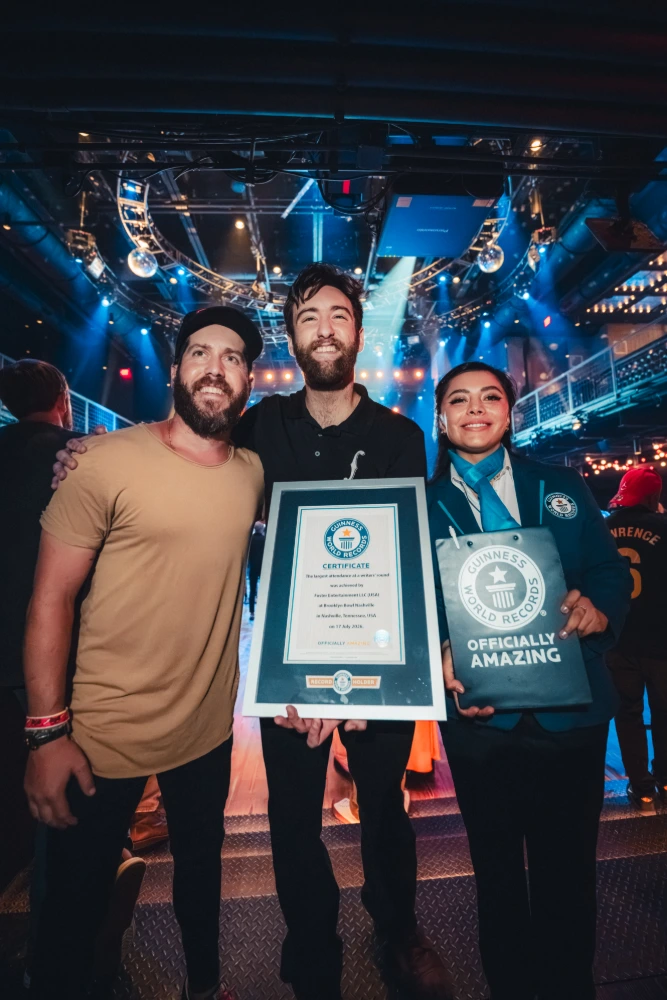 Immediately, the pressure was on.
Brooklyn Bowl’s next available evening was just a month away, leaving Foster little time to coordinate all the details with Guinness and secure the resources needed to make the attempt possible. Weeks were consumed by late-night calls with Guinness representatives in London, fundraising efforts to cover adjudication fees and the logistical challenge of recruiting participants.
Then came a last-minute hurdle to jump. Since this would be a ticketed event, Guinness required at least 250 guests for the attempt to count.
The weeks leading up to the event took a visible toll. Foster was juggling fundraising, logistics and late-night calls with Guinness representatives while trying to keep the ambitious project moving forward.
By the day of the event, more than100 songwriters had committed to participate. Yet, Foster still couldn’t relax. The fate of the record now depended on whether enough audience members would show up.
As the doors opened and guests slowly trickled in, Foster was on pins and needles waiting backstage. Minutes felt like hours. Finally, someone came backstage and delivered the good news.
“We got it.”
An Artist-First Enterprise
Today, Foster sees the record not as a personal achievement, but as reflection of the songwriting community that made it possible.
"The final goal of Foster Entertainment is to encourage local artists to put themselves out there and grow local communities,” Foster said. “Everyone knows each other in Nashville, they just might not know it yet.”
While the Guinness World Record brought national attention to Foster Entertainment, Foster believes its greatest impact lies elsewhere.
“For me, the world record is less about bringing recognition to the company than to the artists themselves who made it happen,” he said. “My deepest hope for this achievement is to make the world more aware of Nashville’s songwriters and the essential work that they do every day.”
Learn More
Discover your path to the music business at Belmont