

Katherine Kennon has spent 25 years co-authoring and revising the field's go-to guide on interior codes and standards
 Katherine Kennon makes the complicated feel simple. As a licensed architect, facilities planner, ADA compliance reviewer and professor in Belmont’s O’More College of Architecture & Design, she has built a career on translating the dense, technical language of the built environment into something design and architecture students can actually use and understand.
That philosophy is at the heart of her book, “The Codes Guidebook for Interiors,” — now in its ninth edition and widely considered the definitive resource on interior codes and standards in the field.
A Winding Road to Belmont
Kennon's path to Belmont is its own kind of story. A Nashville-based architect who spent years working in private firms and later in space and facilities planning at Vanderbilt University Medical Center, she began adjunct teaching in 1994. Her first assignment landed her at O'More College of Design, located in Franklin at that time. She taught there for 11 years before transitioning to Watkins College of Art, where she spent another 14 years as an adjunct instructor.
“I’ve always loved teaching,” Kennon said. “So, when Belmont brought those programs together, it felt like a natural place to continue that work, especially alongside colleagues I had worked with years before.”
She applied to teach in Belmont's interior design department, where she was reunited with colleagues she had worked alongside at O'More years earlier. A year later, when Belmont launched its architecture program, she made the move from teaching interior design to teaching architecture.
Today, Kennon teaches across the full arc of the architecture curriculum, from a foundations studio introducing first-year students to design principles, to upper-level courses on professional practice and regulations in the built environment. The latter, which she has taught for more than 30 years, maps directly onto “The Codes Guidebook for Interiors,” which she uses as the primary text.
"I've built this world around codes," she said. "I understand it so well that I love to make something that most people find very confusing, not so confusing."
Building the Book, Edition by Edition
Kennon's deep familiarity with codes didn't happen by accident. Early in her career, a sign-up sheet circulated around her firm offering a free code seminar. Her boss was puzzled by her interest — she had been hired for design, not for something so technical. Her answer was straightforward: if not knowing code requirements could negatively affect her designs, then codes were critical design information.
Shortly after, the Americans with Disabilities Act was passed, bringing another wave of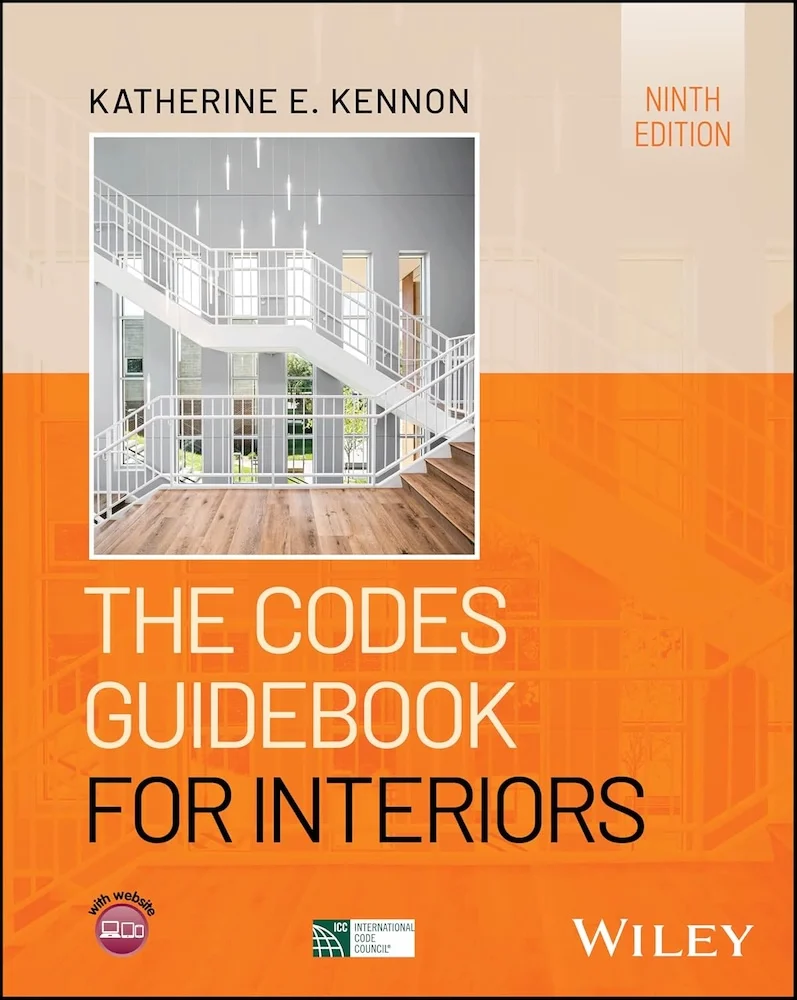 seminars and deepening an expertise that would define the decades to come. Kennon later served as an ADA compliance reviewer for two major Tennessee universities, a role she still holds today.
That foundation brought her full circle to her first teaching assignment at O'More, where she was handed a copy of the first edition of "The Codes Guidebook for Interiors" — written by Sharon K. Harmon, an O'More graduate — and asked to build a course around it. Kennon later invited Harmon to speak to her class, and their professional friendship quickly developed. When the second edition needed updating, Kennon came aboard as co-author, taking on the task of rewriting the book during a particularly complex moment in the industry.
"Everything was changing," she said. "There was no longer going to be multiple regional building codes; there was only going to be one national standard code, and we didn't know what it was going to look like."
Over the following editions, Kennon took on increasing responsibility for the manuscript as Harmon stepped back from the field. Beginning with the sixth edition, the book became solely Kennon's to steward — her opportunity, as she puts it, to continue presenting codes and accessibility to the next generation of designers and architects. The ninth edition marks a milestone as the first to carry her name as sole author on the cover.
A Ninth Edition Built for Today's Standards
The ninth edition reflects the latest updates to national building and safety codes, with new and revised coverage spanning everything from accessibility requirements and energy standards to the full range of buildings designers and architects are likely to encounter in practice. True to the book's founding philosophy, definitions throughout are written in plain language — a standard Kennon defends even when editors push back.
"Sometimes they try to tighten up my language," she said. "And I say, no — I want it to sound casual. I don't want it to sound too strict, or people won't understand it. And that's the whole point of the book."
The classroom and the manuscript have shaped each other for over 25 years. Kennon describes watching students struggle with a concept and immediately rethinking how she has written or explained it. In the book's dedication, she thanks her students for teaching her while they're learning.
"I've heard from students who've graduated and moved on, who say they understood codes better than some of their colleagues," she said. "That warms my heart."
Kennon draws on decades of experience in practice, often using real-world examples and even photos of code violations, to help students understand how regulations play out beyond the page.
What Comes Next
A 10th edition is already in discussion with publisher Wiley, timed to align with the next code update cycle in 2027.
For now, she is exactly where she wants to be — in the classroom, in the code cycle and in the middle of a career that continues to build on itself.
The ninth edition of “The Codes Guidebook for Interiors” is available now.
Learn More
Explore the programs in this story.