

Across campus, Belmont graduate students use inventive research approaches to shape new ideas
From mental health counseling to medicine and the arts, Belmont’s graduate programs provide ample opportunities for students to explore their future fields with purpose and curiosity. Through the research and presentation process, their work reflects a deep understanding that academic advancement can take many forms.
Lauren Massing and Genevieve Dickerson, Master of Arts in English, (‘26, ‘27)
Lauren Massing and Genevieve Dickerson may be in the same graduate program, but the research areas they’ve chosen for their thesis projects couldn’t be more different.
After beginning her thesis research in Belmont’s English department, Massing decided to utilize her love of Victorian literature and explore the novel “Jane Eyre” for her thesis, analyzing how Charlotte Brontë gives Jane autonomy and control despite the Victorian patriarchy’s influence over her life.

Her research offers a compelling perspective. In Massing’s thesis, she makes an original assertion that Jane’s ritual of walking in nature is an embodied theology, or a form of spirituality grounded in lived experience. This serves as a spiritual framework and means of escape from the limitations others impose on her life, as it allows her to emotionally and physically remove herself from society.
“Pursuing my MA at Belmont has been incredibly rewarding,” said Massing. “I’ve grown so much because of the rigor in our program and the confidence I’ve gained through strong mentorship, and the diversity of thought here makes bringing new ideas to established tables exciting instead of intimidating.”
Dickerson’s research is rooted in something far more modern than Victorian literature: forms of linguistic evolution among player groups in the video game “Apex Legends.” After noticing that video game language has largely gone unstudied, Dickerson knew her data collection would need to come from the field instead of textbooks and academic papers. She played “Apex Legends” over the course of several weeks and used player chat logs to analyze how players develop different verbiages to communicate during gameplay.

Dickerson’s research concluded that the most common type of word evolution present while playing was noun-verb conversion, a phenomenon that produces shorter, often monosyllabic words. Dickerson’s thesis argues that noun-verb conversion is the most common linguistic change because monosyllabic word formations are shorter, and therefore more efficient for time-sensitive gameplay.
An avid gamer herself, Dickerson found it only natural to combine her love of e-sports with a fascination for language development that was fostered by her classes in the English department.
“A study focusing on ‘Apex Legend’s’ player base might not sound overtly intellectual, but I strongly believe that students should invest time in what excites them,” said Dickerson. “I love that Belmont gives graduate students the ability to take risks and explore beyond the bounds of a traditional classroom. The support we receive is what makes Belmont so special.”
Kenya Clark Rodriguez, Master of Arts in Mental Health Counseling (‘26)
In a different field, mental health counseling student Kenya Rodriguez noticed how ordinary poster board presentations made it hard for an audience to connect with research and decided to take a different approach to her presentation. Instead of simply detailing her research to an audience, she invited them to participate in the decision-making process for counselors during a session.
“Having my audience participate in the case study helped them understand all of the considerations we carry in this line of work,” shared Rodriguez. “And hopefully, it demonstrated how strongly I will advocate for my clients during practice. It’s really made me excited about where I will go as a clinician.”
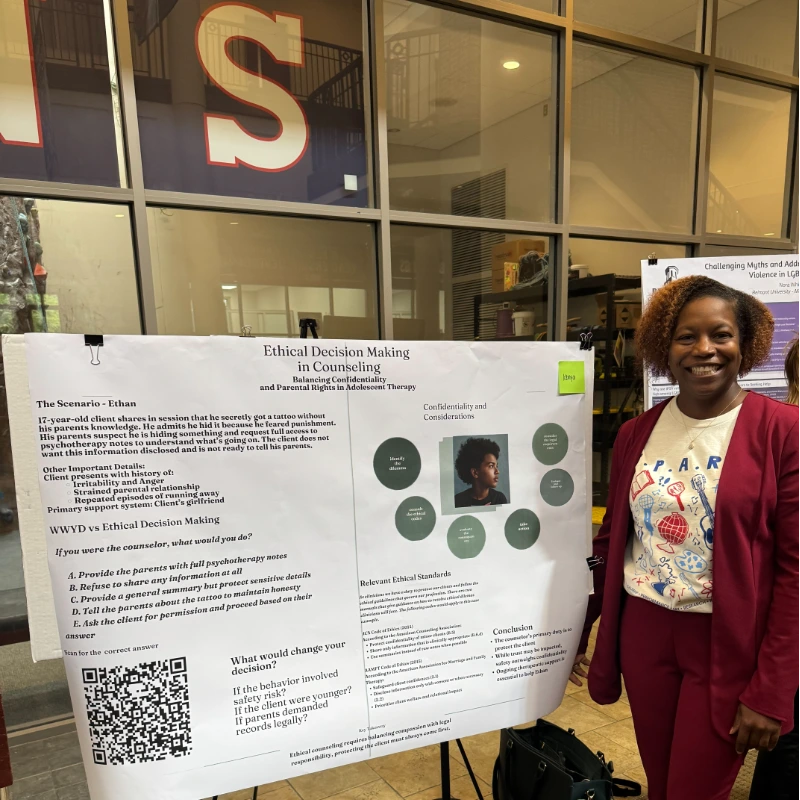
By utilizing guided questioning, Rodriguez placed her audience at the center of a case study that challenged them to understand what counselors can ethically share with a child’s parents about their sessions without violating confidentiality laws. Audience members utilized Rodriguez’s expertise, asking her questions about the case before scanning a QR code and entering their guess from a list of multiple-choice answers. After gathering results, Rodriguez revealed the correct answer and used the poster’s information to explain her reasoning.
“It’s such an honor to present this work,” shared Rodriguez. “I’ve been doing a lot of research into counseling ethics because as the laws surrounding confidentiality change, we must be prepared to advocate to the best of our abilities. Counselors are always challenged to balance advocacy and compliance, and I wanted my audience to experience that as they learned from my work.”
Rodriguez graduated from her master’s program in May and is preparing to enter the University’s Ph.D. in Mental Health Counseling program in August. For her, being able to inform the public about the role of mental health practitioners in the community is exactly the point of research like this.
Matthew Giammanco, Thomas F. Frist, Jr. College of Medicine, Medical Student (‘29)
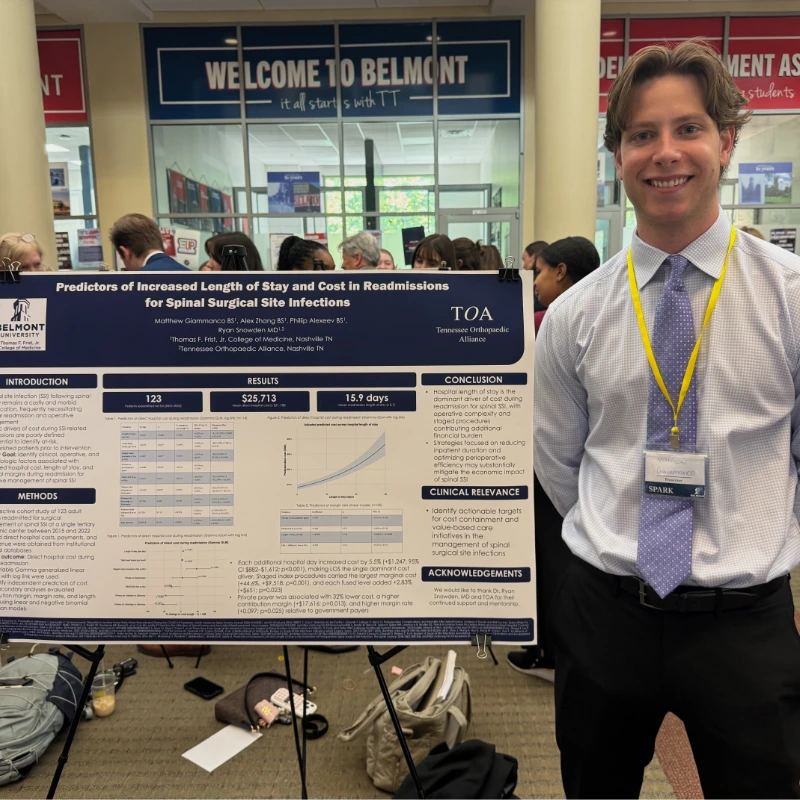
The life of a first-year medical student typically revolves around classes, exams and building a strong foundation for a future in medicine. For Matthew Giammanco, that list also includes joining an orthopedic surgery research team and studying reasons for increased costs for patients who were re-admitted to the hospital for site infections after spinal surgery.
“It was really interesting to discover the specific dollar values that can be directly associated with certain risk factors for infections,” said Giammanco. “This informs us on where we can make earlier interventions to improve future patient care so that they’re paying less and healing more quickly.”
Giammanco’s research consisted of studying a cohort of 123 adult patients who were readmitted to the hospital for infection management after surgery. He and his team compared their findings with itemized hospital costs associated with those surgeries. Their results suggest hospital length of stay as the dominant driver of cost during readmission, meaning that if patient care was more effective and hospital stays shortened, cost would become less of a concern for those facing spinal surgery.
Though he’s keeping his mind open to other specialties, Giammanco has already expressed an interest in orthopedics as a potential future career. He sees his team’s research as inherently valuable to orthopedic surgery, which is often cost-prohibitive to many patients because of its intense nature.
“These procedures do require a lot of money and, depending on your insurance, that can be a big problem for patients trying to heal,” Giammanco said. “Barriers such as cost are a big problem in medicine, so it’s intriguing to determine how procedures can be more efficient and cost friendly. This research reinforces what we already believe: we must practice from a patient-centered perspective.”
Alexis Ignatin, Doctor of Occupational Therapy (‘27)
Similarly, when occupational therapy student Alexis Ignatin began her research into whether water aerobics classes could improve perceived fall risks in older adults, she was prepared to utilize her clinical training to help patients. What Ignatin did not expect was using her extensive background as a cheerleader and dancer to create the aquatic exercises her patients would be doing.
“Dancing and choreography have been a big part of my life for as long as I can remember,” said Ignatin. “It all came so easily to me when thinking about what moves and music our patients would enjoy the most. It’s the perfect intersection of my two favorite things.”
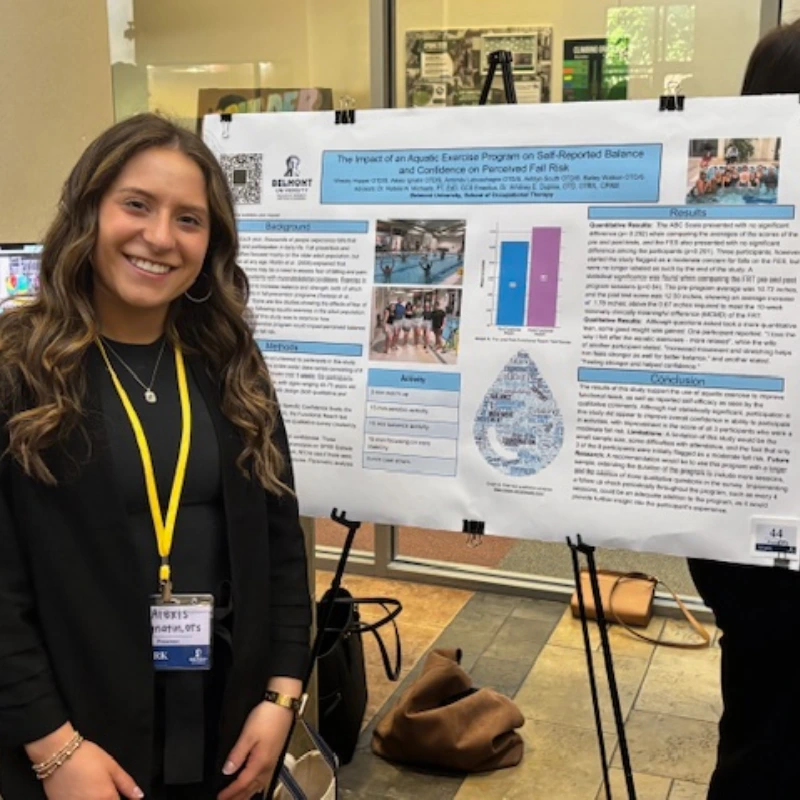
Ignatin’s team required participants to fill out a comprehensive survey detailing their fear of falling and balance issues before and after taking a series of aquatic exercise classes guided by the OTD students at the Coleman Park Community Center. For them, it felt like a fun way to be active with friends, but Ignatin’s team knew the dances were doing so much more.
“Every time patients reach, walk, bend or jump, it builds core strength and balance,” said Ignatin. “And because they’re supported by the water, they can move freely and without fear of being injured. That’s where they developed true confidence in themselves. It was so cool to watch everything come together for our patients.”
Ignatin’s team compared both surveys at the end of the month and observed a significant improvement in participants’ perceptions of their balance and fall risk. In the group’s presentation, they asserted that aquatic exercise should be used to help fall-risk patients and that the study should eventually be replicated at an even larger scale.
For Ignatin, getting to combine her passion and future career for research felt like a significant step in her journey towards graduation and full-time practice.
“Research can be deeply personal and fun while also benefitting others and challenging us on an academic level,” Ignatin shared. “This experience has pushed me to think in new ways for my practice, which is something I will absolutely take with me in the future.”
Graduate studies stand out at Belmont because exploration and discovery are driven by students themselves, resulting in original research that reflects creativity and rigorous scholarship. As these students continue to participate in such research, they become strongly rooted in a passion for their fields and grow their desires to contribute exciting ideas to existing scholarly conversations.
Learn More
Learn more about the programs in this story