

Thomas F. Frist, Jr. College of Medicine professor discusses lifelong learning, the purpose and joy of medicine and the role of Nashville’s newest medical school
Over his career as an obstetrician and gynecologist, Dr. Stephen Staggs built deep relationships with generations of patients, including delivering the children of babies he had delivered decades earlier.
Now, as an associate professor of obstetrics and gynecology at the Thomas F. Frist, Jr. College of Medicine, Staggs brings more than four decades of clinical experience to his work with students. A Nashville native, he counts physician and HCA co-founder Thomas F. Frist, Sr. among the important teachers and guides who shaped his development during his early career.
“I have had the most wonderful life being a physician. There is nothing more fun and joyful than being a doctor,” Staggs shared.
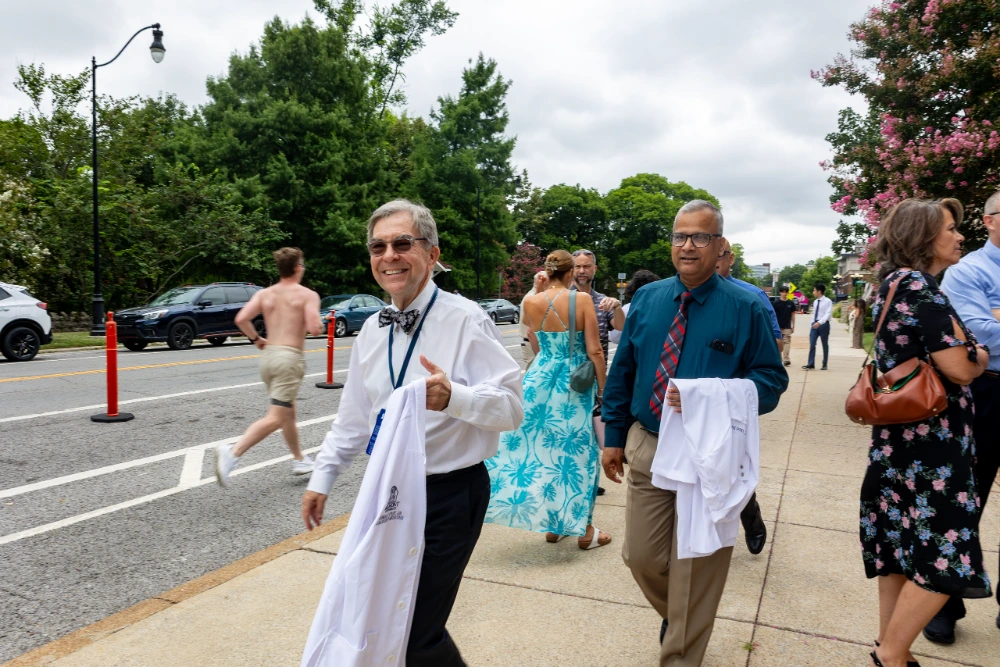 Staggs was one of the first physicians hired at Nashville’s newest college of medicine. When Belmont called to ask him to help build the new school, he recognized the invitation as a call from God. The school’s vision of shaping medicine through transformative whole-person care resonated with the love of learning, curiosity about people and commitment to service that had guided his life and career.
“My approach to life has been guided by 2 Timothy 2:15: ‘Do your best to present yourself to God as one approved by him, a worker who has no need to be ashamed, rightly explaining the word of truth,’” Staggs said. “I carry that verse with me in three words: study, work, discern. They help me focus my purpose — to keep learning, to put what I learn into practice and to discern how to act wisely and compassionately.”
The phrase “rightly explaining” holds particular meaning for Staggs. Discernment calls him to examine his beliefs, weigh evidence, recognize the limits of his understanding and consider what a particular situation requires. For Staggs, this daily challenge helps him integrate science, philosophy and theology into his practice of medicine — a commitment that led him to Vanderbilt Divinity School, where he earned a Master of Theological Studies in 2013, more than three decades into his medical career.
“Divinity school was a continuation of a lifelong commitment to learning,” he said. “It helped me think more deeply about the purpose of medicine, the values that guide my decisions and my responsibilities to others.”
Helping build a medical school with an emphasis on “healing together in humility” reflected his own convictions and felt like a natural way to bring his life’s work full circle.
“Medical education asks us to develop scientific understanding and clinical judgment while also examining our values, our responsibilities and the purposes our knowledge should serve,” Staggs said.
“Medicine is deeply spiritual because it addresses the most fundamental questions about life, death and being human,” he continued. “For me, the goal of a physician is not just to extend life, but to relieve suffering and help people thrive. Doing that requires a relational approach to learning what the patient wants and what makes them feel vigorous and whole.”
He offers the example of a patient with terminal cancer who hopes to attend a grandchild’s graduation. Caring well for that patient involves considering how treatment might affect comfort, energy and the ability to be present for a cherished family milestone, alongside its potential effect on survival.
 When asked why Nashville needs this new medical school, Staggs answered with conviction: “Because we must expand our medical education infrastructure to meet the growing healthcare needs in Tennessee.”
According to the Tennessee Hospital Association’s 2025 workforce report, Tennessee could face a shortage of nearly 3,900 physicians by 2035 without additional action. The report also notes that approximately one-quarter of the state’s physician workforce is over age 65, underscoring the importance of preparing the next generation.
“I think Belmont thoughtfully identified the need for more physicians and wisely chose to meet it,” he said.
For Staggs, the school brings together two longstanding strengths of Nashville: education, reflected in its identity as the “Athens of the South,” and healthcare innovation.
The Thomas F. Frist, Jr. College of Medicine is Tennessee’s fifth allopathic medical school. Three were founded in the 1800s; the most recent before Belmont, East Tennessee State University’s James H. Quillen College of Medicine, was established in 1974.
“Medicine never stops learning, and neither should we,” Staggs said. “My hope and prayer is that I can help guide our students toward the same sense of purpose and joy that I have found in being a physician. I also hope that advances in science, innovations in medical education and improvements in our healthcare system will help them care for patients more effectively and build deeper relationships with their patients and colleagues.”
As a Christ-centered medical school, the Thomas F. Frist, Jr. College of Medicine seeks to fulfill a God-directed purpose: educating physicians who bring knowledge, discernment and compassion to the care of others. We invite you to join us in this work through your partnership and your generosity. Together, we can help our students find purpose and joy in medicine while caring for the people and communities who need them.
Learn how Belmont's medical school develops physicians focused on whole-person care