
From first-semester fieldwork to decades of leadership, Belmont’s College of Education forms reflective, resilient teachers
Across generations, the heart of Belmont’s College of Education remains the same: small classes, deep relationships and an Education Preparation Program (EPP) that forms reflective, resilient educators ready to lead in today’s classrooms.
“I’ve always felt like Belmont’s EPP is second to none,” said Hallie Caddie, Academic and Licensure Specialist at the College of Education.
As a double alumna (English ‘14, Master of Arts in Teaching ‘15), Caddie not only speaks from personally experiencing the program, but she also consistently receives glowing feedback from school districts and clinical observers who remain impressed with Belmont students and graduates.
“We teach resiliency and activity to make sure our students are the most prepared for this job,” Caddie said. “It is an extremely difficult job, and we want them to be the best they can be.”
In the Classroom Your First Semester
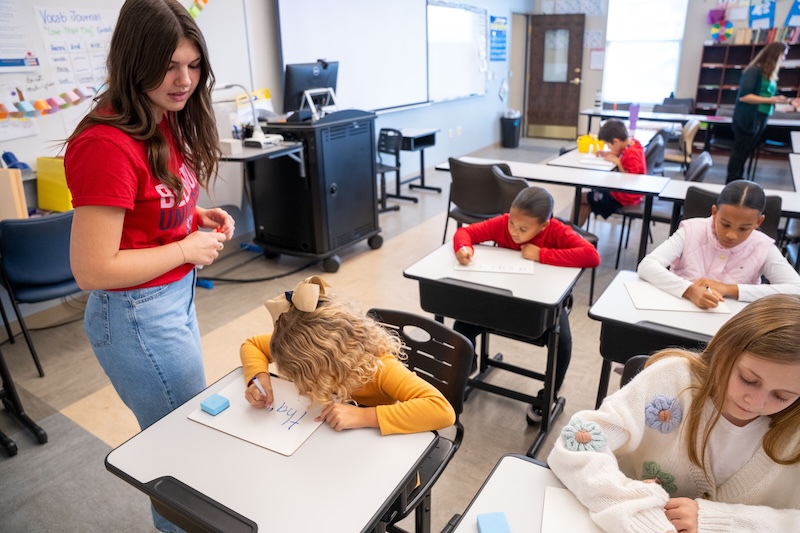
Freshman elementary education and Honors student Elle Thrush is already taking three education classes and spending one day a week in a Metro Nashville Public School classroom.
“We build lesson plans, work with the classroom teacher and then teach the class,” Thrush said. “The next day, we debrief that lesson in our Belmont class.”
As students progress through Belmont’s program on campus, so do their responsibilities in classrooms off campus. Thrush says that early classroom exposure has helped her grow in confidence, forge friendships with her cohort, and build connections with teachers at the school.
Each field experience is intentionally aligned with the coursework students are taking at the time, allowing them to apply new concepts immediately and build confidence step by step.
A Culture of Care
Another highlight for Thrush is the opportunity to build both professional and personal connections with professors who invest in their students.
After noticing she created a midterm study guide, her Foundations of Education professor Dr. Annie Insana sat down after class and spent time talking through how Thrush might adapt that tool for first-graders.
“That moment showed me Belmont really is a place where professors care deeply about their students,” Thrush said. “This one-on-one education is just like no other. My professors model the kind of teacher I want to be.”
Reflective, Resilient Teachers Schools Want to Hire
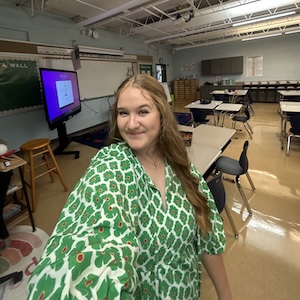 Beyond developing integral building blocks for a strong foundation as an educator, like lesson planning and classroom preparation, Belmont emphasizes building resilient teachers through cultivating the habit of reflection.
In her first year as a second-grade teacher for MNPS, Meagan Boots, who graduated in May 2025 with a degree in elementary education and a minor in English as a Second Language, has seen this attribute set her and her peers apart as teachers.
“If there is one thing that Belmont education graduates can do, it is write a reflection paper,” she said jokingly. “Now, as a teacher, I automatically think about what went well? What didn’t? What can I change tomorrow?”
Reflection is built into nearly every part of the program: hour logs become weekly journals, micro-teachings in the college classroom are recorded then analyzed and students submit end-of-semester reflection papers for each field placement.
This has also become a valuable tool for keeping a healthy mentality for overcoming the rigorous parts of the job.
“It can be easy to get into the mindset of only seeing what went wrong in a day but because I've had so much practice in reflection, I can recognize there are good things that I’ve done too,” she shared. “That definitely helps keep my spirits up.”
Years of Impact in Teacher Preparation
Throughout the decades, Belmont has consistently challenged and equipped students to make real-world decisions about their career paths in teaching.
Alumna Amber Rankin (‘83) chose Belmont decades ago because she wanted a strong education program in a small-school setting. Student teaching during college prevented her from investing years in the wrong fit and ultimately led her into elementary teaching and, later, reading intervention.
The “demanding but supportive” attention from her supervising teacher shaped how she, in turn, poured into her own students in the classroom.
“I’ve had moments when people have reached out to me and said that the year I taught their child was the best year for them, even though it was challenging,” Rankin said.
After a long career in the traditional classroom, Rankin briefly retired only to discover a new calling months later as a literacy coach for MNPS. Today, she draws on her years of experience to train, support and reenergize fellow teachers as they do their vital work in the classroom.
Across generations, these individual journeys — and numerous others — demonstrate how Belmont equips educators to succeed at every stage, from the first semester in the program to the first year in the classroom to decades of leadership in the field.
Learn more about the College of Education at Belmont.