

Listen to the Episode
About the Episode
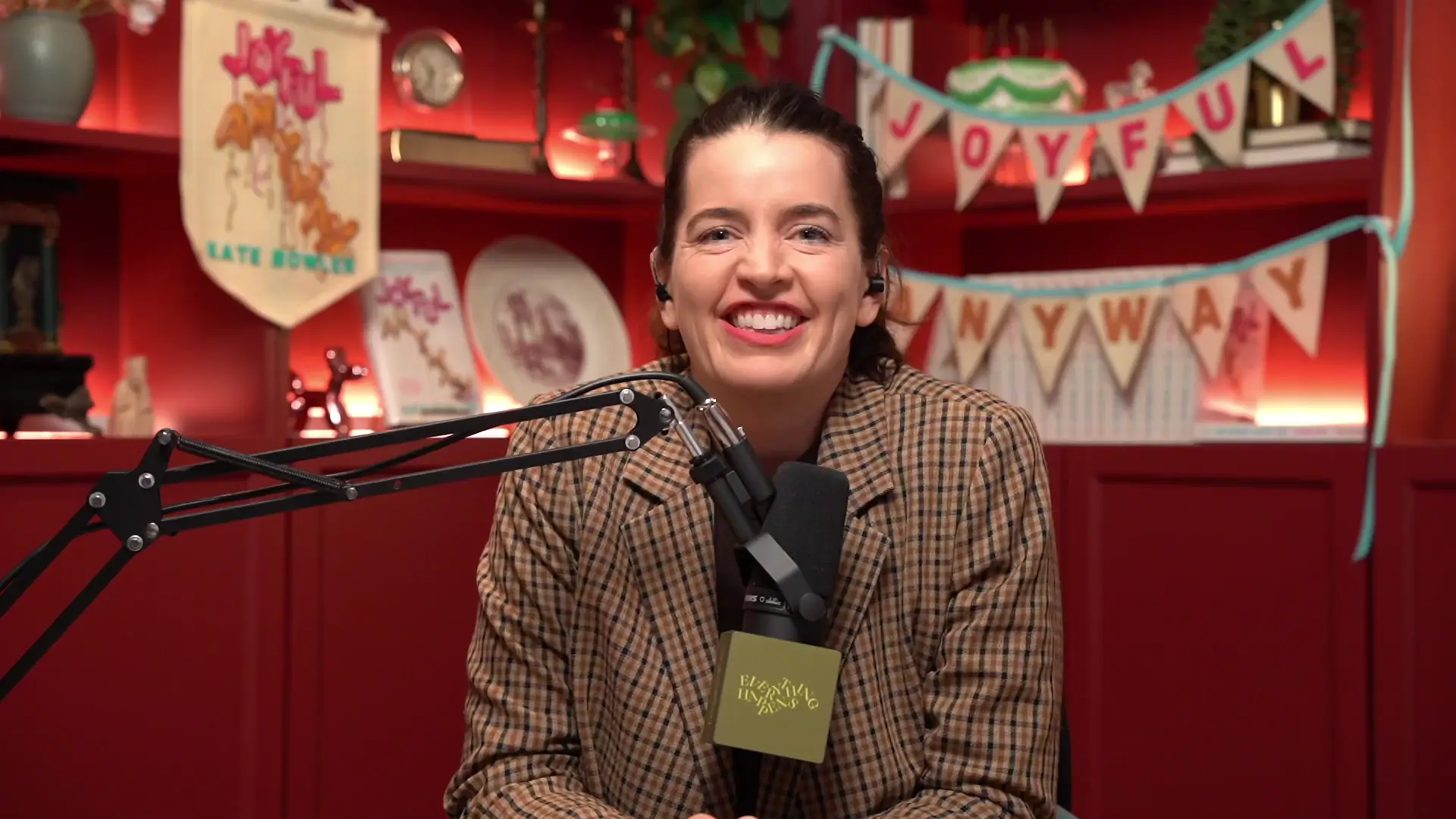
Author, professor and speaker Kate Bowler joins Dr. Greg Jones to explore how honesty, faith and community make room for hope, even when life doesn't make sense.
Joy. Faith. Stubborn Hope.
Life doesn't always unfold the way we imagine.
For Kate Bowler, a stage four cancer diagnosis at the height of her career shattered the illusion that faith guarantees an easy life. Yet rather than abandoning hope, she discovered something deeper: a hope rooted not in certainty, but in honesty, human connection and God's abiding presence.
In this moving conversation, Kate reflects on suffering, toxic positivity, humor and why joy is still possible, even in unfinished lives.
“Honesty is just oxygen, if you haven't been able to use it in a while.”
This episode covers…
- How a cancer diagnosis transformed Kate's understanding of faith and hope.
- Why “toxic positivity” often isolates people who are suffering.
- The difference between optimism and what Kate calls “stubborn hope.”
- When embracing our limitations leads to deeper joy, connection and purpose.

“Even when you want to say ‘no,’ if you just find a little ‘yes’ in there, weirdly, magic can happen.”
The Struggle, the Surrender and the Transformation
Just as life seemed to be coming together — a dream job, a young family and years of hard-earned success — everything changed.
“It was just honestly, it's the speed. It's like the astonishing speed by which you have to lay your own future down.”
Kate describes the heartbreak of receiving a stage four colon cancer diagnosis after years of building the life she believed she had earned. Beyond the fear of illness was an even deeper struggle: trying to understand why.
“I was heartbroken, and I was also very angry because I wanted to feel like I deserved my life,” she says.
As a scholar who had spent years studying the prosperity gospel, she suddenly found herself confronting many of the same questions she'd researched academically. Friends and strangers alike searched for explanations, eager to assign meaning to her suffering.
But Kate realized that the search for reasons often became another burden to carry.
“That was the beginning of me realizing that first of all, this deep loneliness I had in my life coming apart, that I wasn't alone, that everybody is screaming against the void and asking, ‘why them?’”
The Courage to Tell the Truth
Kate believes one of the greatest challenges facing our culture is the pressure to appear okay, even when we're not.
She describes what she calls “toxic positivity,” a mindset that insists every hardship must immediately become a lesson or a blessing.
“America is the number one consumer of promises that we should always be happy, always speak positively,” she shares. “That kind of framework makes it very, very difficult for people to describe realistically what they're going through.”
Instead, she offers a different starting point, one admittedly difficult for many to accept:
“It has to first start with honesty.”
Honesty allows people to become more than observers, Kate says.
“They can actually be a witness.”
For Kate, authentic relationships begin when people stop performing wellness and start sharing reality.
Faith and Stubborn Hope
Hope, Kate explains, isn't pretending everything will work out exactly as planned.
It's learning to trust God without demanding guarantees.
Reflecting on the relationship between hope and joy, she offers one of the most memorable insights from the conversation.
"One of the great reasons why joy is such a cousin to hope is that when it looks at the future that God has made, it lets our soul cry for a second, ‘Yes, we are temporarily whole.’”
Rather than seeing hope as optimism, she has come to understand it as something that survives uncertainty.
“I think now that I know that hope and joy spend a lot of time together, I'm way more into hope,” she admits.
That hope doesn't erase suffering, but it gives us strength to keep moving through it.
Humor as Holy Resistance
Despite years of treatments, surgeries and uncertainty, Kate has never lost her remarkable sense of humor.
She believes laughter isn't a distraction from pain but rather becomes a way through it.
“When the truth really feels too heavy to carry, it is nice to let humor kind of allow a little bit more in through the side door of what we can say.”
One unforgettable story involves chemotherapy, former President Jimmy Carter and a surgeon reluctantly performing a magic trick before removing a surgical drain.
Remembering that moment, Kate reflects:
“Even when you want to say ‘no,’ if you just find a little ‘yes’ in there, weirdly, magic can happen.”
Humor, she explains, helps people become present again, opening them to the reality that healing often begins in connection rather than in control.
Choosing Joy Anyway
Kate's newest book, “Joyful Anyway,” grew from an unexpected realization.
Years after surviving the darkest period of her illness, she still experienced longing, frustration and incompleteness. Instead of seeing those feelings as failure, she learned to embrace them as part of being human.
“God has made us achy and hungry, and we will remain achy and hungry until we are with God,” she says.
Rather than trying to eliminate the ache, Kate began asking where that longing could lead.
“All of that unfinished feeling is actually like stirring up a desire to find more ways to say yes,” she believes. “Yes to service, to all the things that make life rich again without making life fixed again.”
Joy, Kate discovered, isn't reserved for perfect circumstances.
It's found in ordinary moments of gratitude, beauty and love, even while life remains unfinished.
Living with Hope, Living with Humanity
Kate believes we’ve created an increasingly impossible picture of what a successful person is supposed to be: better, faster, optimized, endlessly productive, perfectly polished and “always on.”
That ideal, she says, looks less human and more like the technology we’ve built to improve our lives. But Kate believes our greatest strength will never be perfection.
It will always be our humanity.
“It will be our humanity that reminds us and helps us create all the good things that will remind us all how very good it is that you in particular were born.”
Kate’s message is both deeply hopeful and profoundly freeing:
We don't have to optimize every part of our lives. We don't have to explain every hardship. We don't have to perform constant happiness.
Instead, we can tell the truth, embrace our limitations, care for one another and trust that hope still has the final word.
Stay Connected to The Hope People
Follow The Hope People wherever you get your favorite podcasts, and visit thehopepeoplepodcast.com for ways you can become an Agent of Hope yourself!
For more writings and content from Belmont University and President Greg Jones on the power of hope in our lives, sign up for Greg’s listserv.

Recent Episodes
Stay inspired!
Sign up to be notified about new episodes and more.