
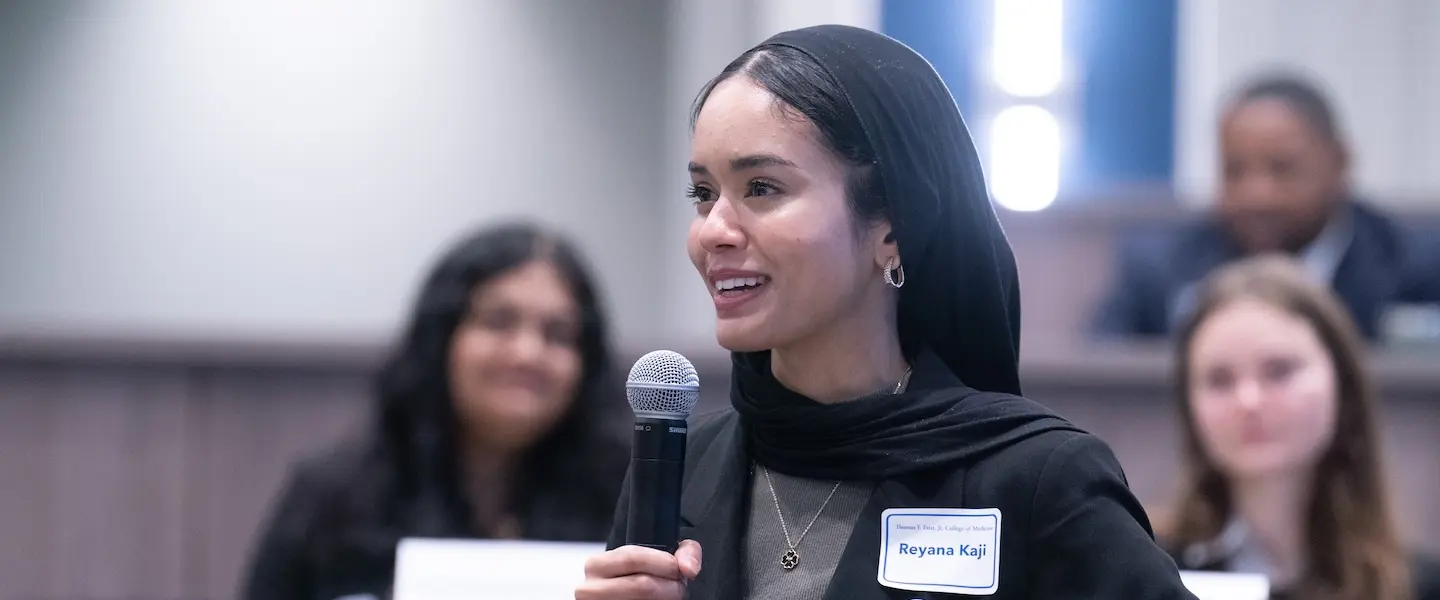
Thomas F. Frist Jr. College of Medicine second-year student builds confidence while helping to build new medical program
Throughout their four years of medical school, we are keeping up with members of the inaugural class of the Thomas F. Frist, Jr. College of Medicine. These students, each with their unique backgrounds, aspirations and perspectives, are not just pursuing their dreams of becoming physicians — they're helping to shape the future of medical education at Belmont University.
Now in their second year, they are moving from foundational coursework into clinical rotations, taking their first board exams and stepping into the hospitals and clinics where they will train as future physicians. Their stories offer a window into the evolving world of medical education and the innovative approach of Belmont's newest college.
Read Reyana's first-year profile to see where her journey began.
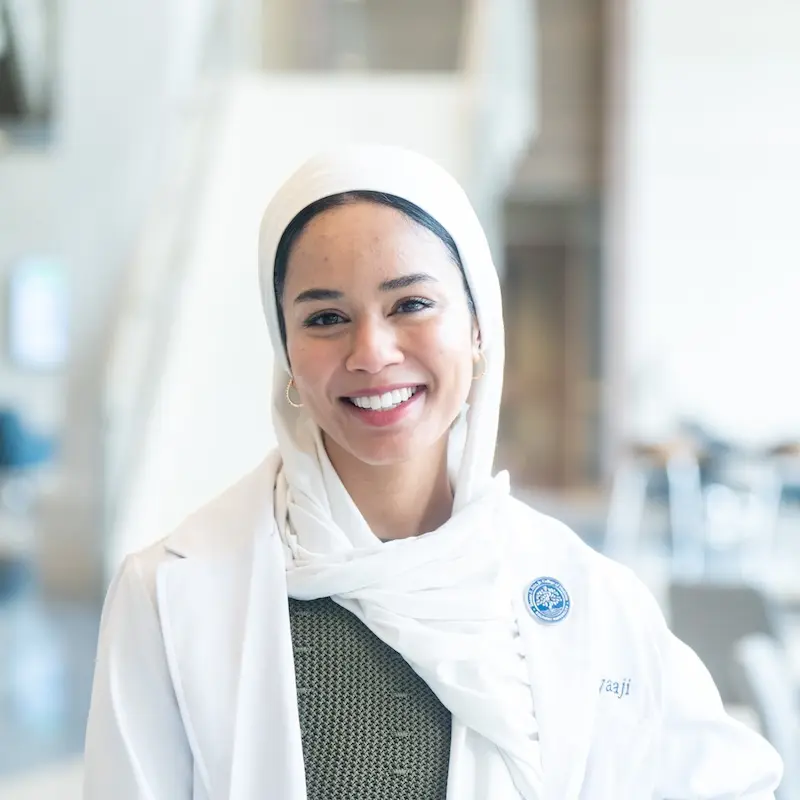 The second year of medical school brings an intensified workload as foundational knowledge from year one is expanded, tested in clinical settings and reinforced through preparation for licensure exams.
As the rigor increases, so does Reyana Kaji’s confidence — in her professors, in her community of peers and in her ability to lead and thrive in year two as a medical student at Belmont University’s Thomas F. Frist Jr. College of Medicine.
“I feel like we've never had a chance to feel any kind of uncertainty or doubt because of how invested, well-organized and passionate our faculty members are,” she shared. “We see them putting in hours of effort day and night. I have no doubt that the medical school is headed towards really great things.”
Leading the Way for Rural Medicine Interest
Each member of Belmont’s inaugural medical school cohort is a trailblazer, and Kaji is no exception. For the Maryland native, things are beginning to click as she works to translate textbook knowledge into meaningful clinical care.
“As our workload increases, somehow things feel easier,” Kaji said. “We were placed into clinics in our first couple of weeks which, at the moment, felt daunting, but I can see the long-term vision now. The earlier you start, the quicker you start making connection with what you’re learning.”
Beyond navigating the rigor of medical school, Kaji and her peers are doing something few students ever experience — helping shape a medical school while experiencing it in real time. One way they are doing this is by creating student-led interest clubs.
Kaji is helping start the Rural Medicine Interest Club, an idea that aligns with her long-standing passion.
“I wanted something that was patient-specific — something all specialties could connect to,” she said. “Rural medicine isn’t one specialty. It’s focuses more on the full demographic, and I think there’s really no better place than Tennessee.”
The club brings students together to explore challenges like health care access, food insecurity and maternal health in a rural context. As the club gains more members, students will work to identify tangible ways to support rural patients.
Learning from Those Who Lead
Kaji credits much of her growth to Belmont’s faculty, whose investment in students goes far beyond the classroom.
“There’s no way to exaggerate the amount of personalized attention we get,” she said. “They’re constantly thinking of ways to help us succeed.”
That commitment is evident not only in curriculum design, but in the mentorship students encounter during clinical experiences. One such moment left a lasting impression.
While working with an internal medicine physician who does outpatient care, Kaji witnessed firsthand how small, personal actions can transform patient outcomes — from helping a patient access exercise resources to helping them qualify for a life-saving transplant.
“His patients adore him because of the commitment that he's given them,” Kaji said. “When I saw this patient in clinic, he owed his life to the physician.”
From her preceptor’s example, Kaji learned to focus on the little things and exhibit similar attention and passion with her patients.
“I think I have a clearer vision of the role I see myself in the future, she said. “I would like to serve a role similar to him — that’s the kind of physician I hope to be.”
A Community That Lifts Each Other
If there’s one word Kaji returns to when describing her experience so far in Belmont’s medical school, it’s community.
In a field often associated with competition, she has found the opposite at Belmont.
“It feels impossible to me that there are spaces that are cutthroat,” she said. “We always help each other. We’re always open with each other.”
That collaborative spirit extends beyond her cohort. Through Belmont’s interdisciplinary model, medical students regularly work alongside peers in nursing, pharmacy, physical therapy and other health sciences, often in Belmont’s Center for Interprofessional Engagement and Simulation.
Those experiences, Kaji said, are already shaping how she approaches patient care.
“We understand each other’s roles better,” she said. “And we can use those strengths to treat patients more effectively.”
Taking the Next Step
As she prepares for clerkships — the next phase of medical school — Kaji knows responsibilities will only increase. But so will her confidence.
“Every step is such an immense privilege,” she said. “You’re unlocking a new part of yourself.”
Still, the most meaningful moments often come from looking back.
“I think seeing the growth — even when it feels small — it motivates you to keep going,” she said.
That growth has brought clarity, too. The goal of becoming a physician feels more tangible with each passing year.
“I hope I can look back and realize I was being prepared for this all along,” she said.
Learn more
Discover medicine at Belmont.