

Belmont Law alumna reaches the nation’s highest court early in her legal journey
Many attorneys spend decades practicing and never work a case that goes before the Supreme Court of the United States. In fact, SCOTUS agrees to review less than 1% of the approx. 8,000 petitions it receives each term.
So, being admitted to the SCOTUS Bar as an associate attorney at Thompson Burton last November marked a rare and early milestone — one she doesn’t take lightly — in the legal career of Belmont College of Law alumna Sarah Ingalls.
“It is not lost on me how lucky I am to have had that opportunity,” Ingalls said. “It is certainly beyond what I would have expected six years out of law school.”
Program at a Glance: Juris Doctor (J.D.)
What degree will I earn? Juris Doctor (J.D.)
What college houses this program? Belmont University College of Law
How long does it take to complete? 3 years / 90 credit hours
What is the bar passage rate? No. 1 among all Tennessee law schools (2023); No. 1 in the nation for highest ultimate bar passage rate two years in a row (ABA)
What is the employment rate? 97% for the 2024 graduating class
What certificates can I earn? Criminal law, entertainment and music business law, health law
What experiential learning is available? Practicum every semester; field placements with organizations including Disability Rights Tennessee, Nashville Metropolitan Council and the Tennessee Court of Appeals
Exploring Possibilities at Belmont Law

After working as a journalist and covering court cases, Ingalls wanted a deeper understanding of the legal field. That curiosity ultimately led her to law school, and eventually to Belmont Law in 2017.
Unsure of which area of law she wanted to pursue, Ingalls felt confident choosing Belmont for the range of opportunities it offered. With certificate programs in entertainment and health law, along with public-sector and government opportunities in Nashville, students can explore a wide range of legal paths before choosing a focus.
“I thought, I’ll be good here because no matter what I want to do, they’ve got me covered,” Ingalls shared.
While at Belmont, Ingalls found mentorship through the Inns of Court and gained appellate advocacy experience through Moot Court, learning to argue whether the law was applied correctly and whether legal errors affected the outcome of a case. Her most formative experience came through judicial clerkships at Belmont.
As a second-year law student, she secured a clerkship with Chancellor Ann Martin in the Chancery Court of Davidson County. There, she gained an invaluable mentor and learned by watching attorneys argue cases in the courtroom.
That experience helped Ingalls discover her passion for litigation.
Today, she handles complex commercial disputes, specializing in issues relating to contracts, property, and employment. Her work frequently brings her before trial and appellate courts, on the state and federal level.
Ingalls was a summer associate at Thompson Burton the summer before her 3L year at Belmont Law and joined the firm after graduation. Now in her sixth year at the firm, she has become a trusted member of the litigation and appellate practice groups, leading her to work on a recent case that reached the Supreme Court.
“I’ve been very vocal about my desire to do more appellate work,” Ingalls said. “One of my supervising partners and mentors, Phillip Young, heard me and gave me the opportunity when he had a case in the Supreme Court.”
From the Courtroom to the Supreme Court
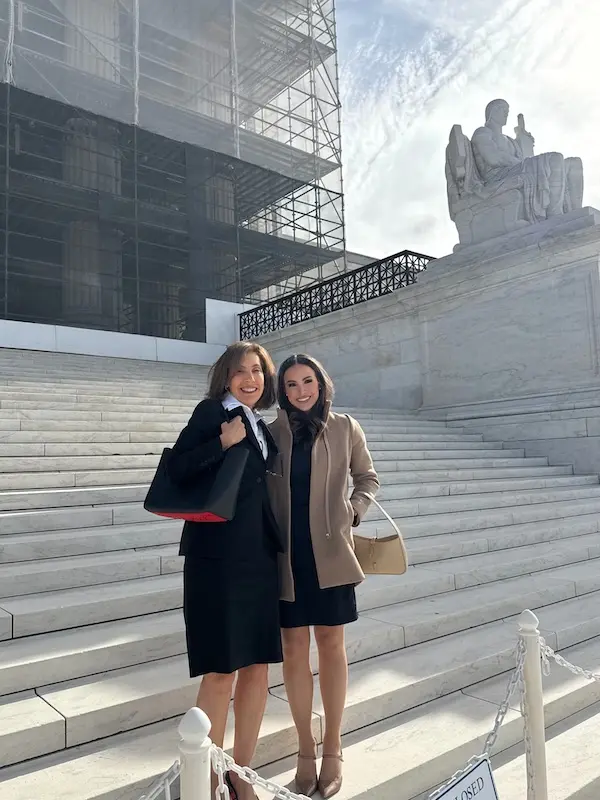 The case focused on how much time is considered reasonable for someone to challenge a default judgment (a court decision made because one side doesn't respond or show up). The Supreme Court ruled in favor of Thompson Burton’s client, establishing important civil procedure precedent.
Ingalls helped prepare for the case’s oral argument and traveled to Washington, D.C. to watch Lisa Blatt of Williams & Connolly in D.C. present the oral argument. The case was Blatt’s 55th argument in the Supreme Court.
“It was fascinating to sit there and see what questions the justices asked and how she responded to their questions,” Ingalls said. “I was very fortunate to have that experience and to get to learn from her and see what her process was in preparing for the argument and briefing."
Beyond learning under Blatt’s mentorship, Ingalls was also admitted to the Supreme Court Bar on motion from Blatt which makes it possible for her to argue before the Supreme Court in the future. “She is the best person I could have asked to move for my admission,” Ingalls said.
A SCOTUSblog report emphasized the potential nationwide impact of the case,” particularly [for] those who may not know enough about the law to realize when to take a legal document seriously.”
Encouragement for Future Bruins
Through hard work and a willingness to speak up about her goals, Ingalls found herself before the Supreme Court just six years after graduating from law school. She now encourages current students to do the same. “If you want something, you have to put it out there,” she said. “People want to help you accomplish your goals, but they don’t know if you don’t say it.”
By following her curiosity, Ingalls discovered a passion for the law — one that has already opened doors few attorneys ever walk through. Shaped by Belmont Law’s rigorous, practice-ready education and a supportive community of mentors and resources, she is building a legal career that is just beginning, with far more still ahead.
Learn more about the program in this story.