

Dr. Tim Schoenfeld’s first book applies psychology and neuroscience to the reading of the Gospels
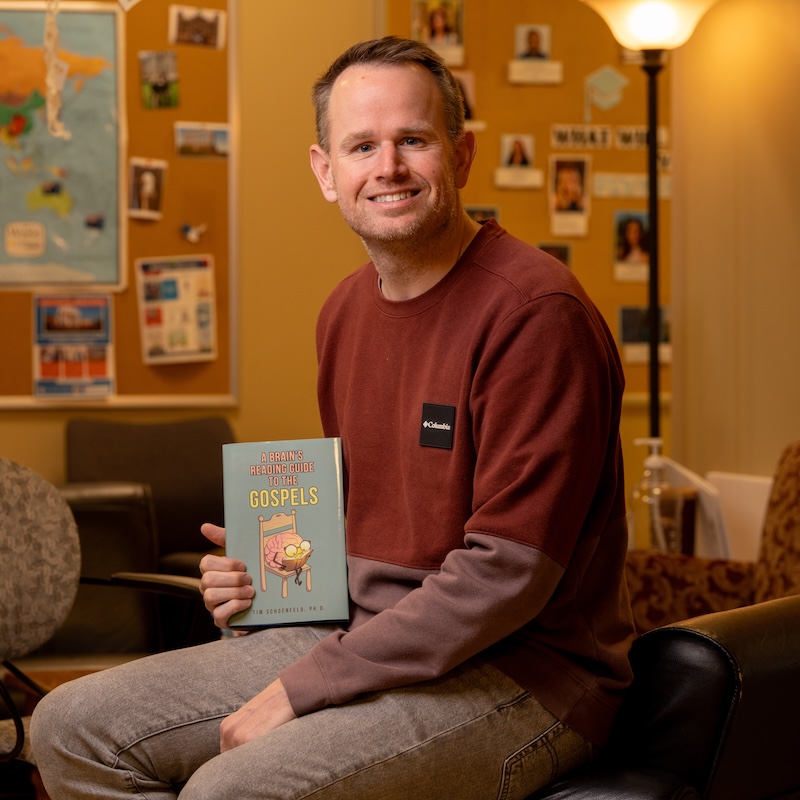
Addressing real-world challenges in the classroom is a cornerstone of Belmont’s College of Science and Mathematics, which often leads to unanticipated inspiration. For Dr. Tim Schoenfeld, the ability to watch his students wrestle with reading the Bible through a scientific lens recently prompted him to explore that same long-standing tension in another way: by writing his first book, “A Brain’s Reading Guide to the Gospels.”
As a Christian, scientist and department chair for Belmont’s psychology and neuroscience programs, Schoenfeld has long held the belief that even just a basic understanding of neuroscience and psychology can enhance one’s experience with faith, whether that be spiritual or academic. In a world where science and faith are often put in conflicting positions, he argues a different stance — that they enhance one another through understanding how emotions, memory and character can signal a deeper significance in the stories being told.
“There’s this idea in pop culture that because science and faith are competing against one another, you have to discredit one side or the other,” Schoenfeld shared. “The focus of this book is narrowed to the Gospels, but I hope it shows that these two big things are compatible, not combatants.”
From Concept to Classroom
As he continued to explore this topic himself, however, Schoenfeld didn’t do it alone; rather, he decided to teach it in a course designed to help students find the intersection of psychology and biblical narratives. To Schoenfeld, the point was to thoroughly investigate the tension between science and faith and look beyond standing impressions of the stories to find ways that psychology could deepen the meaning of the text.
Students in Schoenfeld’s class explored this deeper meaning found in the biblical text through collaboration that encouraged critical thinking, often highlighting their differences and expanding discussion. His top priority was making sure the material was both welcoming and challenging to all of his students, resulting in an energy that didn’t end with the course itself.
“The class is something I’m still really passionate about,” Schoenfeld shared. “On Tuesdays, we would have a normal Psychology lecture, and then Thursdays served as a Bible study where students from all faith backgrounds could understand the Bible.”
A Spark for Sabbatical
Just as Schoenfeld began noticing this discussion gaining traction, he realized that it was time for him to determine what he would work on during his first sabbatical at Belmont. Though he had a semester to decide, Schoenfeld knew his project needed to be something entirely new. Knowing that he had Belmont’s support, his journey in taking his class notes and turning them into a book became that much sweeter.
“For my whole career, I’ve written articles about research and published them in journals where nobody except other scientists will read them. I didn’t know if it was going to be successful or not, but thought it would be fun to take the energy from our class and turn it into a book that anyone could read,” Schoenfeld explained.
A Culture of Collaboration
In reflecting on the creation of his book, Schoenfeld expressed his appreciation for Belmont’s constant challenge for faculty to think outside of their own boxes, creating an environment where experimentation and creation is constant, even when topics seem impossible to connect. Being able to explore how passions intersect with one another brought Schoenfeld to the realization that he wasn’t alone in his pursuit — Belmont’s community was right alongside him.
“As a campus, we really value interdisciplinary learning, and I’ve seen that the longer I’ve been here. Faculty from different colleges like to work together and even use the classroom as another place for experimentation,” Schoenfeld added. “Belmont values when faculty members try new things. Even if you fail, they want you to keep trying.”
Applying Science to Everyday Faith
In describing his hopes for the future of his work, Schoenfeld expressed that he wants the book to be a reflection of the takeaways his freshmen discovered in class — that even if your beliefs are different, applying a scientific lens to your reading of biblical figures can only enhance understanding of their characters and behavior.
“It’s a science-centric book that applies science to the day-to-day aspects of faith. I think the purpose of the book is that anyone can learn a little bit about psychology and neuroscience,” Schoenfeld said. “People can see how these scientific disciplines can impact the experience of reading characters such as Peter or the Good Samaritan.”
Closely exploring the Gospels of Matthew, Mark, Luke and John through a psychological lens, the book delves into topics such as memory, behavior and character. Published through WestBow Press in the fall, the book is now available for purchase on Amazon.
Learn more about the sciences at Belmont