
Interdisciplinary project animates Col. Gary Bridges’ account of aerial firefight
When Connor McIntyre, a senior manager at Amazon, approached Dr. Gary Garrison, professor in the Jack C. Massey College of Business, about participating in an innovative AI-powered storytelling project last summer, Garrison was immediately intrigued.
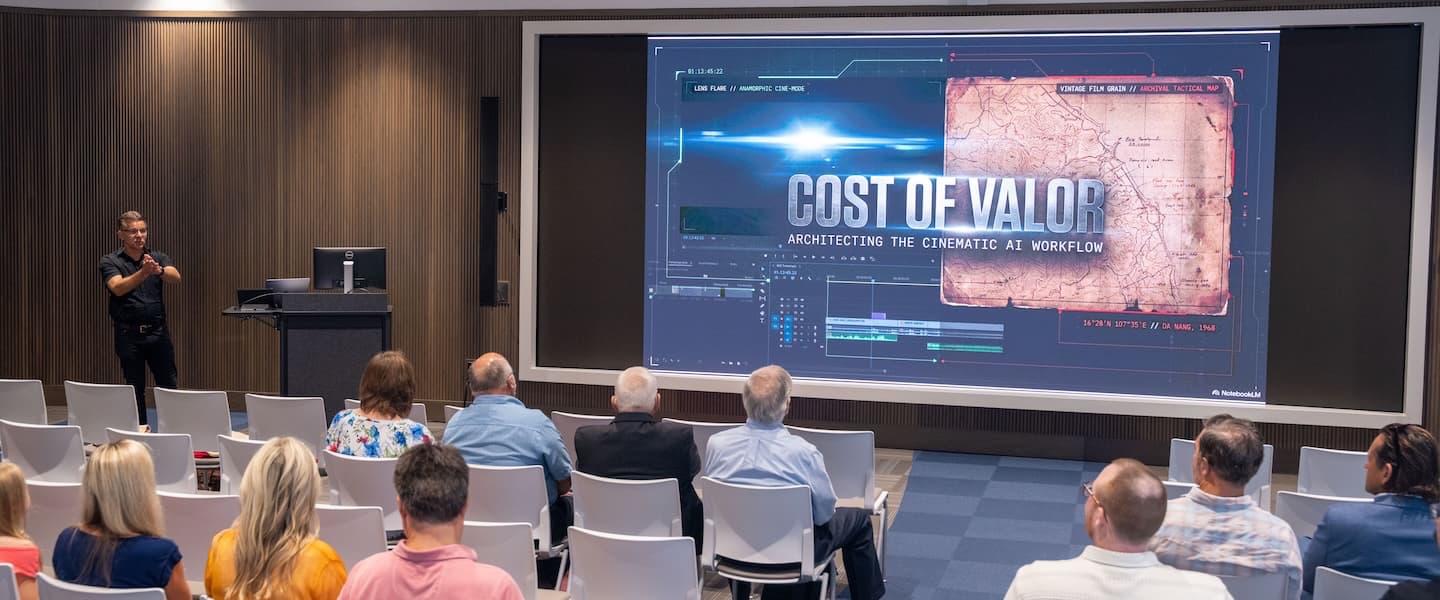
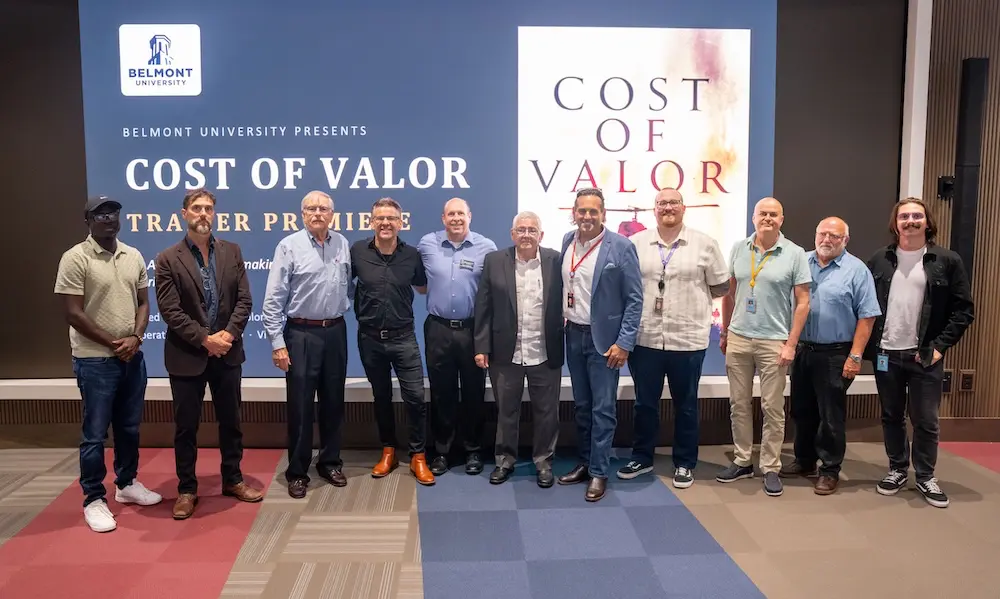
More than a year later, Garrison and a team of Belmont faculty presented the results during a filmmaking showcase before a select audience consisting of industry professionals, academics, military veterans and veteran support staff on campus, July 2.
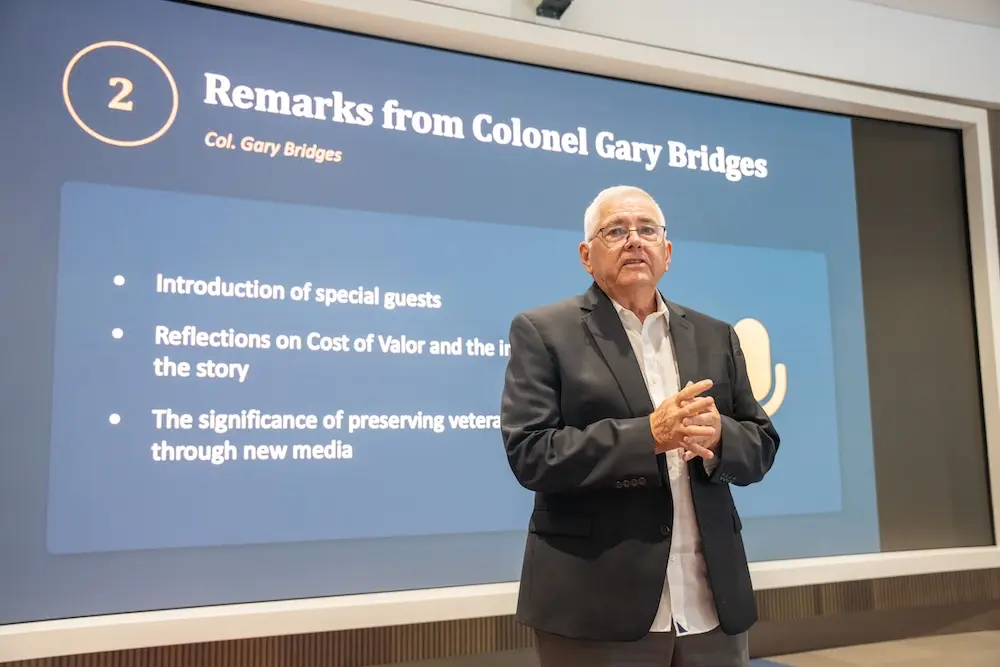 Designed to generate interest among prospective donors, strategic partners and supporters, the project produced two AI-generated sizzle reels based on retired Army helicopter pilot Colonel Gary Bridges’ novel “Cost of Valor.” The trailers serve as proof of concept for future feature-length productions exploring Bridges’ firsthand account of Operation Lam Son 719 during the Vietnam War.
Using emerging AI filmmaking tools, the faculty team visualized the scale, intensity and complexity of the battle and the experiences of the soldiers who fought in it.
The battle came at a staggering cost. Of the approximately 725 helicopters that supported the operation, 108 never returned, more than 600 sustained battle damage, more than 100 pilots lost their lives and 19 remain missing today.
“This is their story,” Bridges said. “And it's a story that I felt needed to be told.”
Recognizing the need for expertise from multiple disciplines, Garrison assembled a team of collaborators from across Belmont's campus, enlisting Dr. Nathan Adam and Jake Mahaffy from the Mike Curb College of Entertainment & Music Business and Dr. Emmanuel Saka from the Watkins College of Art.
Together, they embarked on an interdisciplinary project using emerging technologies and creative storytelling to highlight an important chapter of American military history.
Bringing History to the Screen
Drawing from Bridges' firsthand experiences, the two trailer-style films recreate the aerial combat environment depicted in Bridges’ novel of the same name, “Cost of Valor,” while demonstrating how emerging AI-enabled filmmaking technologies can help visualize historical events in new, compelling ways.
“It's worth noting that everything that you see was generated with AI,” Adam stated at the presentation. “The more we created with the various AI image and video models, the more we found various limitations, challenges and then some things that were surprisingly easy to make spectacular.”
One reel presents the project through a cinematic lens, immersing viewers in the action and emotional stakes of the battle. The second adopts a documentary approach, combining historical context and personal testimony from the Bridges’ novel into the creative process.
Innovation in Service of Story
Using emerging AI filmmaking tools, the team explored the bounds of visual storytelling while confronting the realities and limitations of rapidly evolving technology.
Creating historically accurate depictions proved especially challenging. AI systems often generated imagery that appeared realistic at first glance but contained significant errors. Aircraft configurations, military equipment, uniforms and environmental details frequently required careful review and correction.
The team also encountered challenges with AI-generated human characters, which often appeared overly polished or uniform which detracted from the goal of looking authentic.
Safety restrictions built into AI platforms created additional hurdles when depicting military conflict, requiring faculty to develop creative solutions that balanced historical fidelity with platform limitations.
“We had to get creative to invoke the feeling of this terrifying moment that has happened without necessarily showing it,” Adam said. “That led to a lot of creative prompting to work around the scenario of creating that visceral energy without actually showing some of the things that the AI video models would simply reject.”
The process involved iterative prompting, visual testing, historical verification and repeated refinement. Human expertise remained essential at every stage, reinforcing an important lesson about artificial intelligence.
While AI can generate remarkably convincing content, authenticity still depends on informed human oversight.
Lessons for Education and the Future of Creative Work
While the project honors a pivotal moment in military history, it also serves as a real-world case study in how artificial intelligence is reshaping creative work. In fields such as filmmaking, visual effects, design and music production, conversations surrounding artificial intelligence continue to generate both excitement and concern.
“Tomorrow's professionals will not simply operate AI tools; they will design workflows, evaluate AI-generated outputs, and ensure the final product meets technical, ethical and professional standards,” Garrison said. “Whether in business, healthcare, education or the arts, the ability to lead AI-assisted projects with judgment and integrity is becoming a defining professional competency.”
For students preparing to enter industries undergoing rapid transformation, understanding the opportunities and limitations of AI has become increasingly important.
"As technology continues to reshape the creative industries, Belmont remains committed to exploring how innovation can be used to preserve important stories, foster interdisciplinary collaboration and prepare future generations to use emerging technologies with wisdom, integrity and purpose," Garrison added.
The project demonstrates how foundational skills in storytelling, critical thinking, historical research and artistic craftsmanship remain indispensable, even as technological tools evolve.
Honoring Service and Sacrifice
At its heart, “Cost of Valor” is about honoring those who served.
The short films offer audiences a glimpse into a helicopter battle that influenced the evolution of Army aviation tactics, training and equipment well into the 21st century.
In recognition of the team’s efforts to preserve that history, Lam Son 719 pilots Ed Newton and Don Elmore presented the faculty members with the Challenge Coin and the Army's 223rd Combat Aviation Battalion Blue Star Patch.
For Bridges, the project represents another step toward ensuring that the sacrifices of those who served are not forgotten.
Watch the Cost of Valor trailers.