
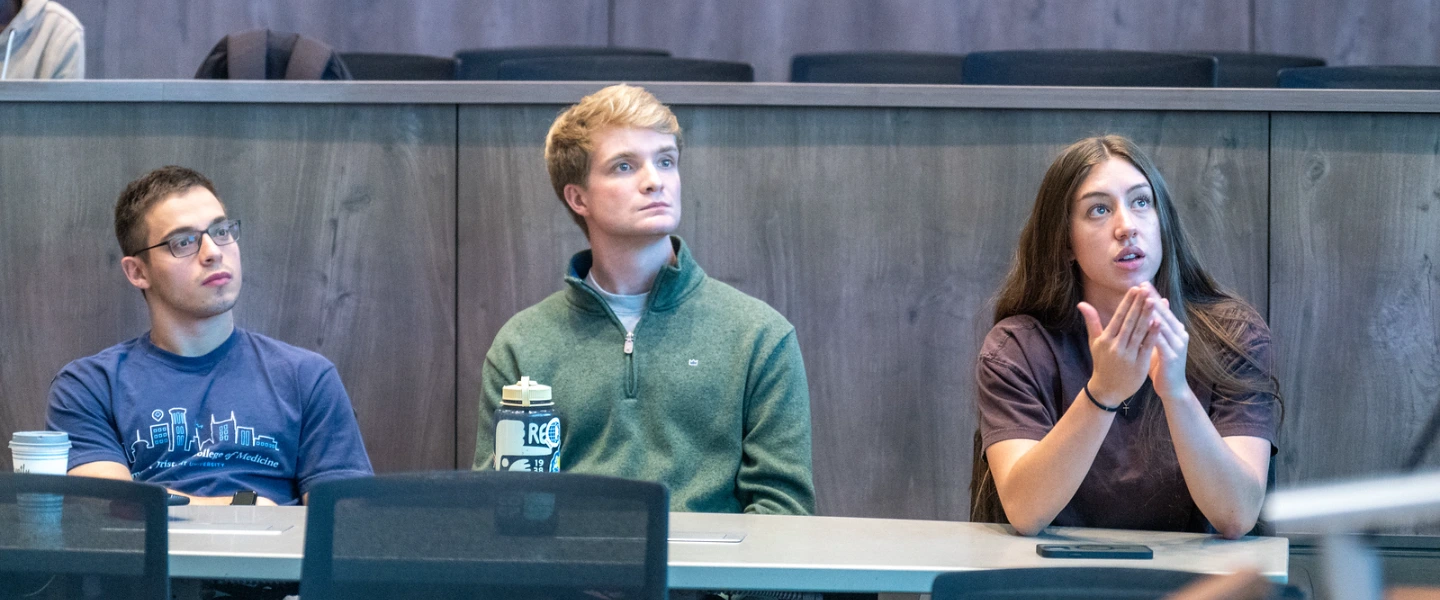
One of Belmont's inaugural medical students has spent two years mastering medicine and learning how to live well while doing it
Throughout their four years of medical school, we are keeping up with members of the inaugural class of the Thomas F. Frist, Jr. College of Medicine. These students, each with their unique backgrounds, aspirations and perspectives, are not just pursuing their dreams of becoming physicians — they're helping to shape the future of medical education at Belmont University.
Now in their second year, they are moving from foundational coursework into clinical rotations, taking their first board exams and stepping into the hospitals and clinics where they will train as future physicians. Their stories offer a window into the evolving world of medical education and the innovative approach of Belmont's newest college.
Read Kenzie's first-year profile to see where this journey began.
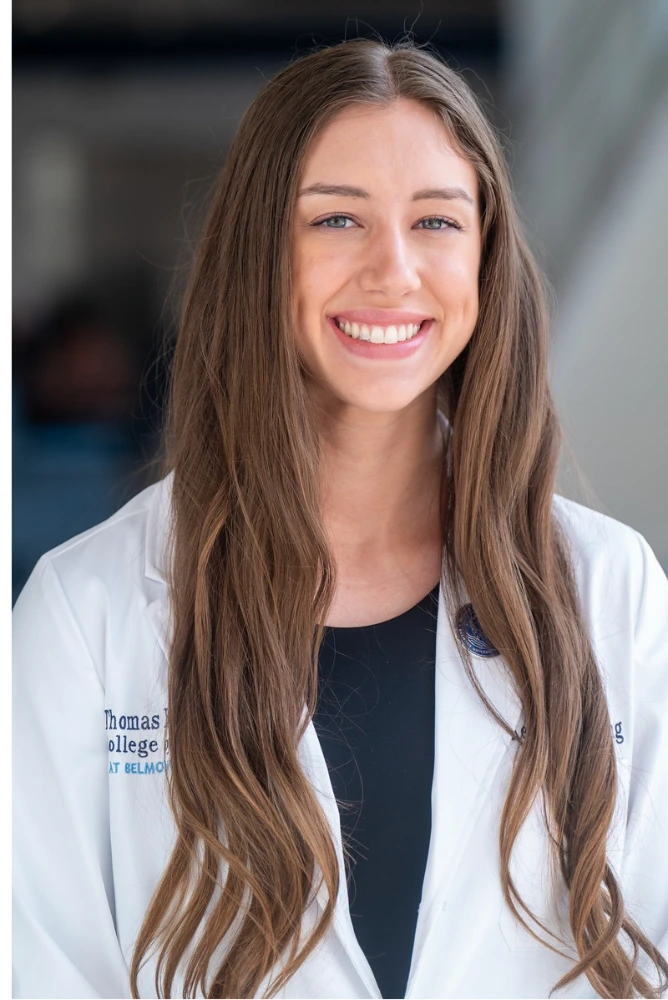 Two years after enrolling as a member of the inaugural class in Belmont’s Thomas F. Frist, Jr. College of Medicine, Kenzie Rushing is preparing for one of the biggest transitions of her medical education.
With the foundational phase of her curriculum drawing to a close, she will soon enter a dedicated period of board exam preparation before beginning clinical clerkships in May — a shift that will take her out of the classroom and into direct patient care for the first time.
"I've absolutely loved my experience as a medical student," Rushing said. "I love what I do, I love learning and I love that I'm going to be able to take my learning to care for patients eventually."
Learning How to Learn
Rushing arrived at the Thomas F. Frist, Jr. College of Medicine having already demonstrated remarkable academic efficiency — she completed her undergraduate chemistry degree at Belmont in three years, having earned her associate's degree in high school. But medical school, she said, required building something new from the ground up.
"I feel like I learned how to learn in medical school," she said. "They tell you when you get here that it's like drinking out of a fire hose, and that's exactly what it is. But then you get to the other side of it and realize how capable you are."
That growth extended beyond study strategies. Rushing said mastering time management has been the key to maintaining the balance she set out to protect from day one.
"I think the stereotypical med school experience is framed around so much suffering, and I rejected that notion from day one," she said. "When I got here, I knew I wanted to really enjoy my experience."
Helping Build Something New
As a member of Belmont's first-ever medical cohort, Rushing has had a hand in shaping nearly every aspect of the program, from curriculum feedback to student organizations built from scratch.
She co-founded the medical school's Christian Fellowship alongside two classmates, serving as vice president of a club that has since grown to include first-year students. As the class prepares to shift into board prep and clerkships, Rushing and her fellow founders recently passed leadership to the incoming class.
Rushing also serves as wellness chair on the medical school's Executive Council, a role that has allowed her to bring her personal values into institutional practice. A key initiative she helped spearhead was getting walking pads installed in the school so students can stay active while they study.
"You can't be a good student if you're not taking care of yourself," she said. "Just the same way you can't take care of your patients if you're not taking care of yourself."
She also works as a peer academic leader — one of the program's first — offering individual tutoring and group study sessions for first-year students.
A Summer in the Field
Between her first and second years, Rushing participated in the college's rural health summer elective, partnering with a federally qualified health center through the Primary Care and Hope Clinic to research gaps in patient communication. 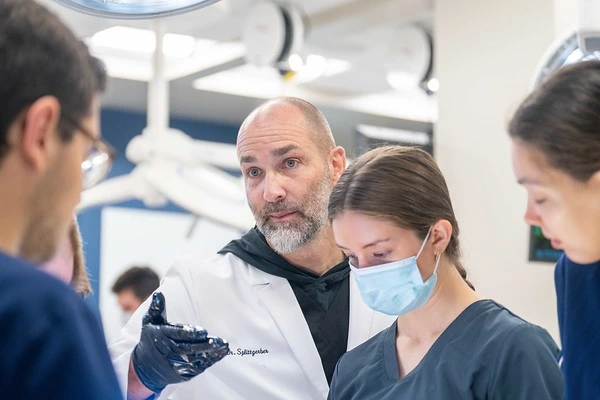
She and a classmate conducted patient interviews examining why so many patients weren't using the clinic's online portal, a tool the clinic had identified as key to improving communication and satisfaction scores.
Their findings pointed to a simple problem: most patients didn't know the portal existed. The pair developed a three-step implementation plan to help the clinic improve patient education, including informational posters and a nurse-led introduction during patient encounters.
“We helped solve this problem, but I also got to talk to patients and get to know them on a person-to-person level," Rushing said. “That was really sweet.”
A Shift in Direction
Perhaps the most significant change since Rushing's first year as a med student is the one she didn't see coming: a complete rethinking of her specialty path.
She arrived at the Thomas F. Frist, Jr. College of Medicine expecting to pursue orthopedic surgery, inspired by the surgeon who treated her through three knee injuries in high school. Two years later, she sees her future somewhere else entirely.
"I've actually learned that I really love longitudinal care," she said. "I love stories. I love the idea of building a trusting patient-physician relationship."
Rushing now envisions a career in family medicine, potentially with a sports medicine fellowship — a path that would let her hold onto her passion for musculoskeletal health while doing the kind of whole-person care she finds most meaningful.
"I feel like you can truly do that to its fullest potential in a primary care role," she said.
Looking Ahead
As clerkships approach, Rushing said she is most excited about something deceptively simple — being with patients.
"I think the biggest role as a med student will be just to make patients feel seen and heard," she said. "I don't have all the knowledge of the residents or the attending physicians, but I will have more time with the patients, and if I can just go and make patients feel seen, that will be what I'm there to do."
For students just beginning the journey she is now completing, Rushing's advice is practical: don't make things bigger than they are.
"If you realize what your purpose is — for me, that's to love people well — then a single exam doesn't feel like the end-all be-all," she said. "You'll never be a first-year medical student ever again. Try to make the most of the experience."
Learn More
Explore the Thomas F. Frist, Jr. College of Medicine