
Undergraduate researchers tackle real-world problems from mosquito resistance to electromagnetic radiation effects
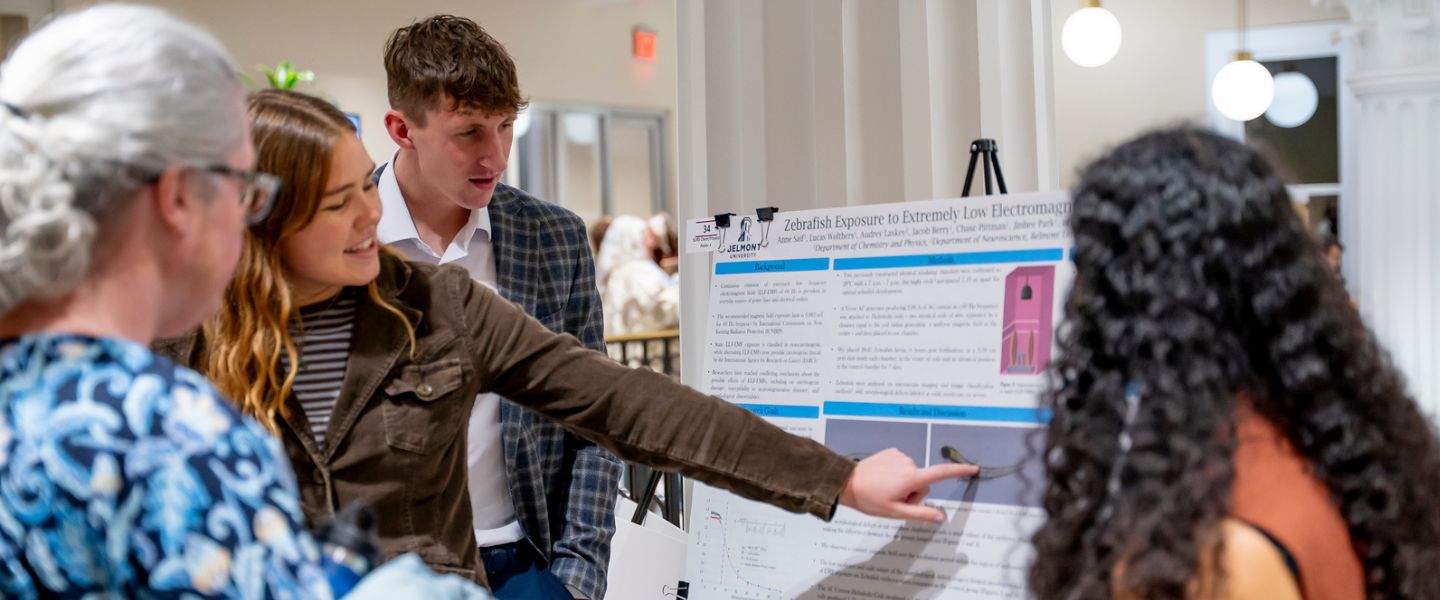
The College of Sciences & Mathematics' annual Science Undergraduate Research Symposium (SURS) showcased the next generation of scientific innovators as students presented research spanning from public health threats to everyday radiation exposure.
The symposium, which featured presentations from over 200 students across biology, chemistry, physics, mathematics, computer science, psychology and neuroscience, provided undergraduates with crucial experience presenting complex research to diverse audiences — a skill essential for their future careers.
"Getting to do this as an undergrad was really cool and helps prepare me for my next steps," said Ellie Sebaugh, a senior biology major whose research on mosquito pesticide resistance has already impacted Nashville's public health strategy. "It mimics how science is communicated and presented in the professional world."
Fighting Disease One Mosquito at a Time
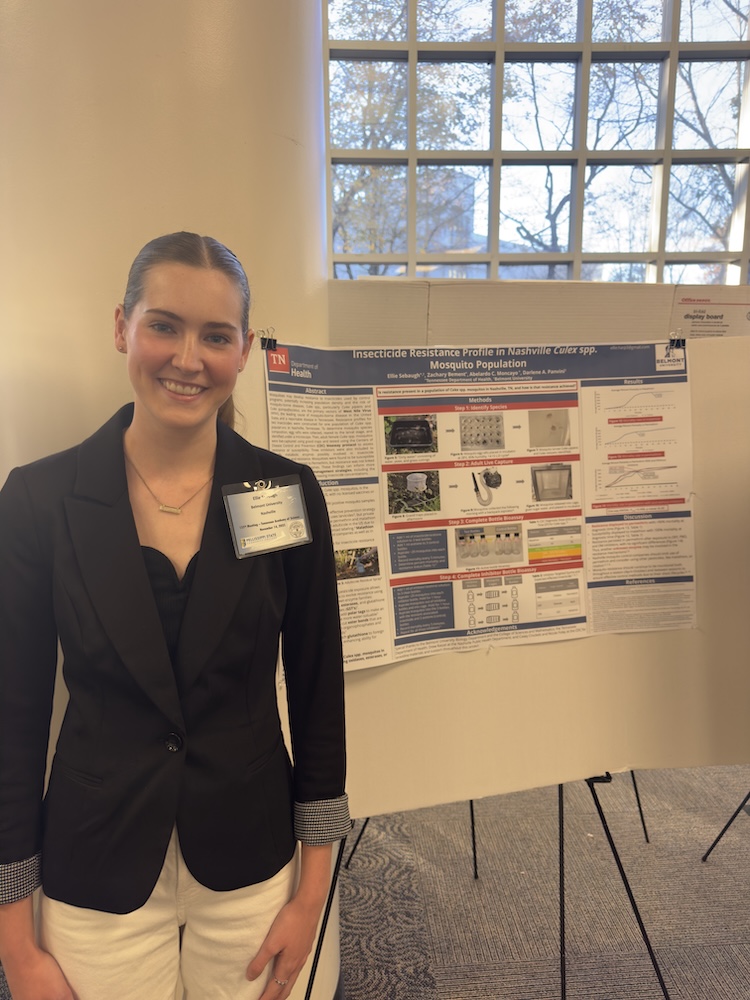 Sebaugh's research, conducted during her internship at the Tennessee Department of Health, revealed a concerning discovery: mosquito populations in Nashville have developed resistance to permethrin, a commonly used pesticide. With West Nile virus having no licensed vaccines or medications, this finding has immediate implications for public safety.
"To actually see that I have a mosquito population in Nashville, where I live, that is resistant to this really commonly used pesticide — I was pretty shocked," Sebaugh explained. "It made me realize how important it is to keep doing studies like these and monitoring how mosquitoes are responding to our treatments."
The impact of her work extends beyond the laboratory. Sebaugh's findings were shared directly with Nashville's mosquito control department, informing local strategies to protect the public against mosquito-borne diseases.
"I'm really proud that my research and my findings actually did make an impact on my own community in Nashville," she said. "It's really rewarding to know that your work can make a difference."
Working under the mentorship of Dr. Darlene Panvini at Belmont, along with Dr. Abelardo Moncayo and Zachary Bement at the Tennessee Department of Health, Sebaugh gained valuable leadership experience. Rather than simply following protocols, she was empowered to lead her own project with support when needed.
The experience has shaped Sebaugh's post-grad plans. After graduating in December, she'll pursue a master's degree in veterinary medicine at the University of Florida's Emerging Pathogens Institute, with hopes of eventually working as an Army scientist on infectious diseases.
Investigating Invisible Forces
While Sebaugh tackled visible pests, sophomore biochemistry major Anne Saif investigated an invisible presence in our daily lives: electromagnetic radiation. Her research examined whether the constant exposure to 60-hertz frequency electromagnetic radiation from power lines, electrical outlets and wireless devices affects development.
"Electromagnetism is everywhere," Saif explained. Working with zebrafish — a model organism for human development — she and her research partner Lucas Walters applied alternating current electromagnetic radiation to test for developmental impacts. 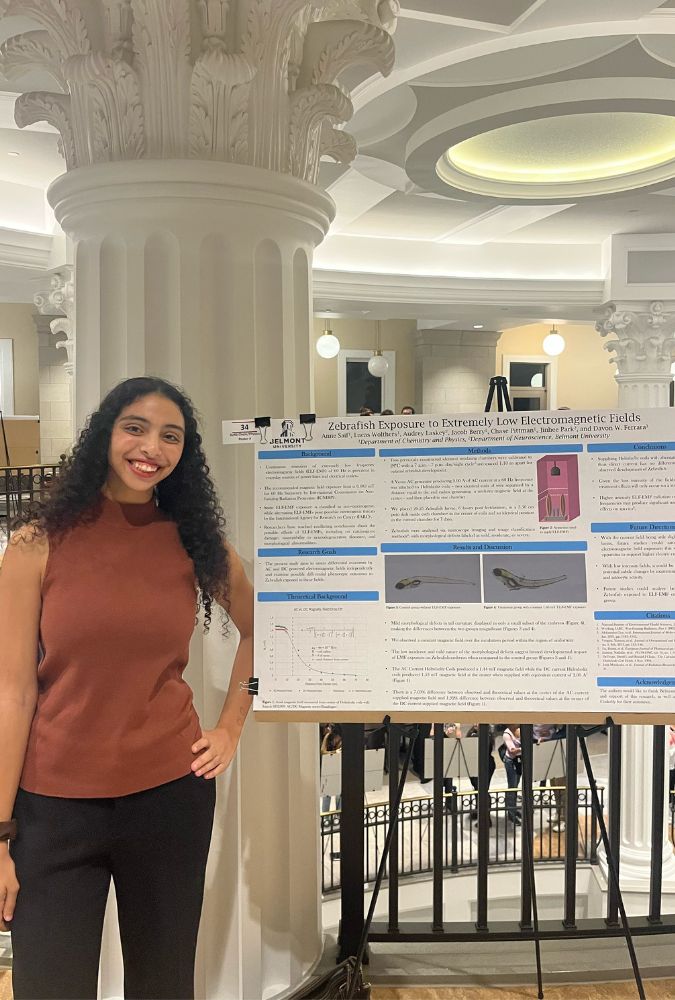
The team, which began their work during Belmont's Summer Undergraduate Research Fellowship program, constructed their own apparatus to ensure consistent application of electromagnetic radiation. While they found no significant large-scale effects at their tested field strength of 1.43 milliTeslas, Saif noted small differences in zebrafish curvature that warrant further investigation.
Under the mentorship of physics professor Dr. Davon Ferrara, Saif discovered not just scientific findings but a new career path. Initially planning to attend medical school, the research experience completely changed her trajectory.
"I really just don't want to give up the research," she said. "I have a love for learning, and research is constantly learning and evolving — it’s something I want to continue to do."
Beyond the Classroom
What sets SURS apart from typical classroom presentations is the diverse audience and the vulnerability of presenting original research. Both students emphasized how the experience challenged them to communicate complex scientific concepts to audiences ranging from expert professors to curious parents.
"I could talk to professors about nitty-gritty details, like the biochemistry behind resistance," Sebaugh noted. "But then I could also talk to my friends' parents and tell them what a mosquito egg looks like and ways they can help protect themselves."
For Saif, the experience was both nerve-wracking and rewarding. "It's vulnerable, putting everything you worked on for a whole semester out there," she said. "But the people that do come up want to talk about it — they are interested, and they have questions you can answer."
As SURS demonstrated, Belmont's undergraduate researchers aren't just preparing for their futures — they're already making meaningful contributions to scientific knowledge and public health. Whether protecting Nashville from mosquito-borne diseases or investigating the effects of our electromagnetic environment, these students exemplify the real-world impact of undergraduate research.
Learn More
Explore the College of Science & Mathematics