
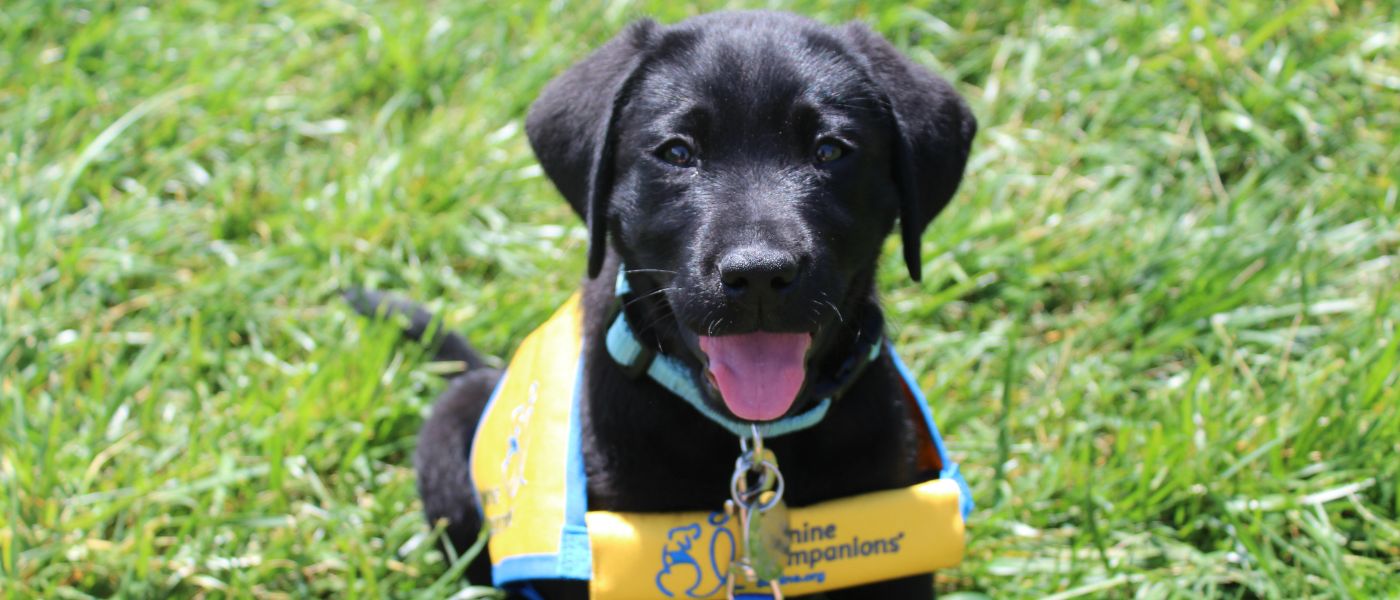
Paddy brings joy to campus while training for greater purpose
Seven months after arriving as a tiny 12-pound ball of fur, Paddy has become a beloved fixture at Belmont — providing stress relief for students while training to one day transform someone's life as a service dog. 
The golden retriever-lab mix arrived on Good Friday as the Collar Scholars program's first service dog trainee, placing him with physical therapy student Morgen Wilkes. Now approaching his first birthday, Paddy accompanies Wilkes everywhere, spending his days learning alongside PT students in McWhorter Hall.
“He truly was perfect from day one,” Wilkes said. “I got extremely lucky with his temperament. Paddy has been mellow since he was a tiny puppy, and that energy is really what allows him to make such a difference here.”
A Calming Presence During Stressful Times
 While Paddy's primary purpose is training for service work, his presence has created an unexpected benefit for Wilkes' classmates navigating the demanding physical therapy program. During breaks between classes, students regularly gather around Paddy's spot in the classroom.
"You know exactly where Paddy is because of the crowd of people around him," Wilkes said.
The impact becomes especially apparent during high-stress periods. Though Paddy isn't allowed in the classroom during exams, students seek him out immediately afterward.
"Picking him up after exams, everyone is like, 'I just need some Paddy time,'" Wilkes said. "The relief that even having him around and the amount of people who come up to me and ask to pet him — they're just so joyful.”
Learning to Serve Through Structured Training
Paddy's journey began at Canine Companions' breeding facility in California, where all their service puppies are born before being flown to volunteer puppy raisers across the country. Since she picked him up from the airport, Wilkes has followed Canine Companions' detailed 100-page training manual, attending classes twice monthly and working through specific commands appropriate for his developmental stage. 
Paddy has progressed to handling most environments, from grocery stores to church services, though Wilkes carefully chooses when to bring him based on training opportunities.
"If I want to go to the grocery store and I want it to be in and out, and I don't want to take the time to make sure he's obeying and learning, I wouldn't bring him," Wilkes explained. "That's not beneficial for his future."
Between noon and 1 p.m. most days, students can find Wilkes and Paddy on the lawn outside McWhorter Hall, where she uses her lunch break for training and play. Paddy carries his own backpack filled with toys and supplies, maintaining an "on mode" for work and an "off mode" for socialization, triggered by specific release words.
Deepening a Calling to Serve
The experience has reinforced Wilkes' commitment to helping others regain independence — the same motivation that led her to physical therapy. Now in clinical rotations on Mondays, she sees firsthand patients who could benefit from service dogs like Paddy.
 "Seeing patients that have the needs that would qualify them to have a service dog like Paddy and then seeing how they are working in real life has also deepened my passion for helping people gain independence," Wilkes said. "My eyes have been opened to how beneficial and helpful these dogs are."
When Paddy returns to Orlando for professional training in August 2026, he'll undergo medical and temperament testing to determine his specialty. Different dogs are matched with different types of service work based on their temperament and abilities — some may assist people with mobility challenges, while others help those with hearing impairments or other disabilities.
"Being able-bodied, I can manage my daily activities independently, which isn't the case for everyone," Wilkes said. "Supporting this program means we're not just helping others with their physical needs but also alleviating the mental and emotional challenges they face."
Growing Interest on Campus
Paddy's presence has sparked increased interest in the Collar Scholars club, with several graduate students inquiring about involvement and potential puppy raisers stepping forward.
For Wilkes, the most rewarding aspect isn't just the training milestones but witnessing Paddy's daily impact on those around him.
"The impact that he'll have on someone one day will be something that you'll never be able to put into words," Wilkes said. "It's so moving to see the stories of how these dogs have changed so many people's lives."